'Is this me, or is this you?' - When dancing turns infectious.
The barista should have known that this was inevitable. A quick look at the two versions of 'Let It Out' from 'The Guy Who Didn't Like Musicals' and the Reprise! What changes were made?

Truly, I had believed that after the previous song ranking post, that I'd be done with it; Or at least done with it permeating my article writing.
Then the actual Pro-Shot for the new version of The Guy Who Didn't Like Musicals was released and I'm right back where it had all started: The Starlight Theatre.
Oh, and how it's changed since then...
So what can I say other than...
In fact, I think there's a song left in me yet.
The show's setup:
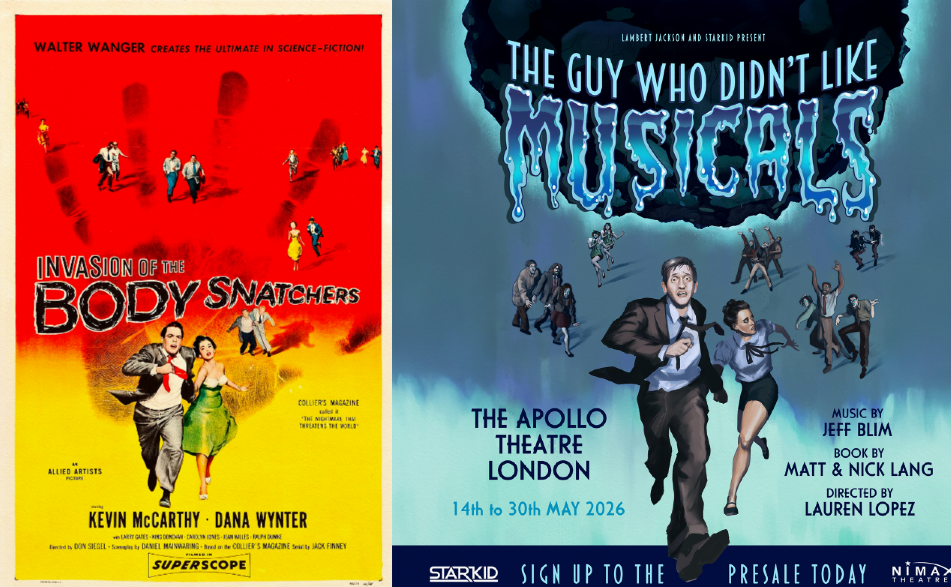
The general plot, and the (reprised) musical poster, sharing a familiarity with Invasion of the Body Snatchers (USA, Siegel, 1956).
Probably one of the more interesting elements is the way the show is structured. Even though the show includes and certainly alludes to many concepts of musical numbers; Their presence is never quite as normal as in any other musical.
The normal understanding of a Musical suggests that the inclusion of singing or dancing is the result of emotions that cannot be contained by simply words. Thus reflecting the intensity of emotion through these means - and are not always to be considered diegetic within the world itself. Though, many shows will muddle the line between diegetic and non-diegetic numbers.
Now - in this show specifically - the singing and dancing is diegetic; That fact was what made it abnormal, and what made it a threat. It is the visual and audible representation of the infection spreading.
One major change between the musicals are the way that the danger is presented. Previously, while always malicious, the physicality of the actual threats had been limited. There were a few instances - such as Lah Dee Dah Dah Day - where the hive mind would attempt to include Paul more directly, or have him forcefully engaged physically. However, those instances were far and between, and seemed mostly character specific.
This new version of the tale is far less kind. Here the physicality is the norm, and it isn't just Paul that gets dragged around but all of the cast. It's more violent and the threat seems more direct as the hive moves the uninfected in accordance to its expectations...
Nonetheless, the story itself remains the same. The number of uninfected dwindled until there were only Emma and Paul left. They attempted to flee the town, but their escape helicopter had already been compromised leading to another fight in close quarters and a crash. This incident left Emma too injured to flee, and it was her that told Paul that their best chance of survival lied in the destruction of the source of the infection: the meteor at the Starlight Theatre.
As Paul makes his way towards the stage where the meteor had hit, the hive too moved to return to its roots. There they were lying in wait for... their main actor.
They disrupted Paul's attempt at closing in, and begin to engage the other in a conversation - All with a specific goal in mind: to stall.
Because the hive knew more about this place than Paul, they knew the potential that could be found at this local.
That's why it was bothering Paul, why it kept asking for Paul to elaborate on his want. It's been a long day, and wouldn't this be the perfect opportunity to let all of these intense emotions out?
...that's when the music kicked in.
The Guy Who Didn't Like Musicals (2018)
It's already been mentioned that this song could be considered my all-time favourite song from the Hatchetfield-Universe.
Paul Matthew's slow apotheosis due to the proximity to the spores of the hive mind itself had always been a fascinating watch, and a brilliant performance.
While truly happy for the existence of the pro-shot, I find myself mourning never having had the chance to see this performance live; Especially since the focus on facial close-up left online only audiences in the dark regarding the complete staging.
Thus, some of my points are based on certain assumptions made due to the choices from the pro-shot.
From the video I'd made one critical assumption: the hive's choreography is actually rather limited throughout this song as the spores take root within Paul. It delights in watching Paul's suffering, it encourages the internal conflict through nodes and keeping the man surrounded; But they hardly infer after Paul had been compromised.
Not that they had held back before. As they'd encouraged Paul to sing, the hive appeared in groups of two; Touching Paul in multiple ways - potentially as a means to aid the spread of the spore - maybe just to keep the man distracted.
First it's Mr. Davidson and the Greenpeace girl, followed by Nora and Bill, and last Hidgens and Ted. They all invade Paul's personal bubble as they keep the song going; All the while Paul's expression reflects how revolting the touch still was to him.
As the song moves on, the hive reaches the song's chorus: a repetition of the phrase "Let It Out".
In this case, this very clearly refers to Paul's missing song. Isn't this a high intensity moment for Paul? Isn't this where words aren't enough any longer - isn't this the point where one should sing?
And it's this moment, where the audience - and Paul - are made aware of the real threat in the theatre; That Paul's corruption had already started, as his body convulses in ways which resemble a dance number.
Interestingly, it's this forced move that removes his hands from the grenade; The means to end this whole farce...
To me, this is when I'd come to the conclusion that this song truly is meant to be stalling for time. The repetitive chorus of "Let It Out" is simple and can be kept up for as long as they need. All they have to do is to stall for long enough for the number to receive its leading man.
Even as Paul tries to deny them - his desperate attempt to refuse them - he fails. His refusal instead being sung in tune, leaving him shocked.
It is at this point where the pro-shot of the show focuses quite a bit on Paul's facial expression, as it reflects the duality now within him clearly. There is the unbridled joy enforced by the hive, and the continuous panic as the man realises what was happening to him.
Throughout this scene there are a few hints of more dance moves - though not always clearly visible - and a more violent reaction when Paul tries to expel whatever has been infecting him.
The hive watches, it nods, and it remains mostly still. They're surrounding Paul and watch his performance. This is mostly a solo number, their own movements are rather stiff in comparison, as if they are holding back. As if they refuse to intrude as Paul slowly succumbs.
To be completely fair, this was his time to be in the spotlight; His time to shine.
At least that's how I've been reading the pro-shot. Since the camera focus is mostly on Paul throughout the second part of the song, it's harder to fully interpret the move-set of the hive.
However, from this decision we can infer that the hive remains rather stagnant. The few glimpses present showcasing mostly nodding, or swaying motions, while remaining in their respective positions.
Not that I fault the editors for the choice to focus on Paul. There is a visual conflict present and it's clearly visible on Paul's face. Thus, picking an extreme close-up to capture these emotions was the logical choice.
The way Paul's demeanour kept switching between pure elation, fear, and disgust was one of my personal favourite moments of the number itself.
Now, what I've always liked about this sequence of events and its performance was how it defined Paul as a non-musical person. His moves were uncontrolled, and out of sync with everyone else as it forced itself upon him. The actions were untethered for the most part, though, Paul still remained in rhythm; The spores could at least ensure that. However, there was no clear or smooth choreography. It's choppy, awkward, and random in its presence. It perfectly resembled "Paul Matthews" in a way - the body was learning and adapting; Forced to follow these new urges.
This then meant that any of Paul's attempt at stopping the infection, and to destroy the meteor, were more visibly distinctive. The dance stops, he tried to speak instead of sing; He would resist and fight until he managed to pull that grenade pin...
So, how did they transpose this number for its reprisal?
The Guy Who Didn't Like Musicals (2026)
I'd already touched on the subject of physicality. This newer version did not shy away from playing with the non-infected. They will enforce THEIR choreography onto their future victims. In this version, non-participation has become a near impossibility.
Mr. Davidson's initial touch was more direct, it began even earlier. Additionally, it was in time with the music as he moved his hand to grab hold onto Paul. This was quickly followed up by Nora and the Greenpeace girl approaching. Nora then raised her arms, not quite touching Paul, and in the background we could see the hive imitating her movements. Even here, it's clear that the hive itself seemed more connected - Their moves feeling more in sync and tied together than before.
Quickly after, Nora took hold of Paul's body and swayed it in time with the music; Once again, the hive was repeating the notion as visible through the movements from the Greenpeace girl.
Paul was as uncomfortable as he'd always been at this point, and then he's already grabbed by Hidgens, who moved him backwards. More specifically: He's placing Paul into position, all the while the others had moved to their respective spots.
As the chorus started to build up, Hidgens let go of Paul to position himself as well.
The tension has been rising, and the song has built up to - dance.
This time, Paul's moves are no longer awkward or random. They function in-sync to the hive.
First, he moved his hands in the opposite direction as the hive, downwards (and away from the grenade), while they had raised theirs. However, Paul's body sways like theirs - following the rhythm - and as the hive repeats the action; This time pulling their hands down, Paul, too, repeats the notion.
Realisation starts to hit him, as the lack of control became more obvious, and Paul tried to move his hand to cover his mouth. However, the hive reacted. They moved closer and swiped with their arms as the music kept going, and Paul's body followed this new rhythm. His hand left his face and his body kept swaying...
He hunched over, tried to deny them once more as they moved in, and - like in the original - Paul failed.
This scene read so differently this time. Yes, there was dancing involved - but there is a focus on the hive that hadn't been as present in the original. Not only that, but there is a deliberateness in the actions of the hive that had been missing in the original. It had put Paul into position. They ensured that the spotlight would hit him, that he's where he was supposed to be.
Just like in every number before, they'd ensured that participation was guaranteed; And this time, this time Paul couldn't escape them.
It was also this more connected synchronicity that lead to the return of an age-old questioned that had been asked in the original version too:
"Is this me, or is this you?"
In the previous version, most of the conflict had been limited to Paul's conflict with the infection within him. His actions, not quite his, but clearly distinguishable. The dance was the other, the refusal was Paul.
Even if the lyrics were Paul's refusal and denial to participate, the fact that they were sung were the means of the other.
This time? This time the question is elaborated upon differently; Because whose number is this? Whose choreography were we following?
Now, I already indicated that the first section of this song was clearly guided by the hive itself. It played with Paul, stalled him, and put him into position for his grand entrance.
However, this isn't quite the case in the after any longer. After Paul finds himself shook by his first sung note, the hive rejoices. They grab onto him, and pull him forward. Still ready to keep him in the middle. The limelight; the focus point.
Paul, though, refuses. He tried to leave. Tried to refuse participation, only for the hive to have adapted to this new move-set just as quickly. The spotlight followed Paul, shining purely on him while the hive kept dancing in the dark. Their moves now a reflection of Paul's.
What has previously been a visual battle between solely Paul and the infection that took root in his mind, has now grown; The distinction between refusal and dance having become less obvious, as the hive simply integrated them into the overarching choreography.
Though, there are still rather obvious distinctions to be made: whenever Paul's body refuses to reach for the grenade, or whenever Paul's expression switches from elated to afraid. Elements of the original are still present, it's just that the hive had been given a more proactive - a more visually present - role.
Though, they did fall back as soon as Paul's real solo began.
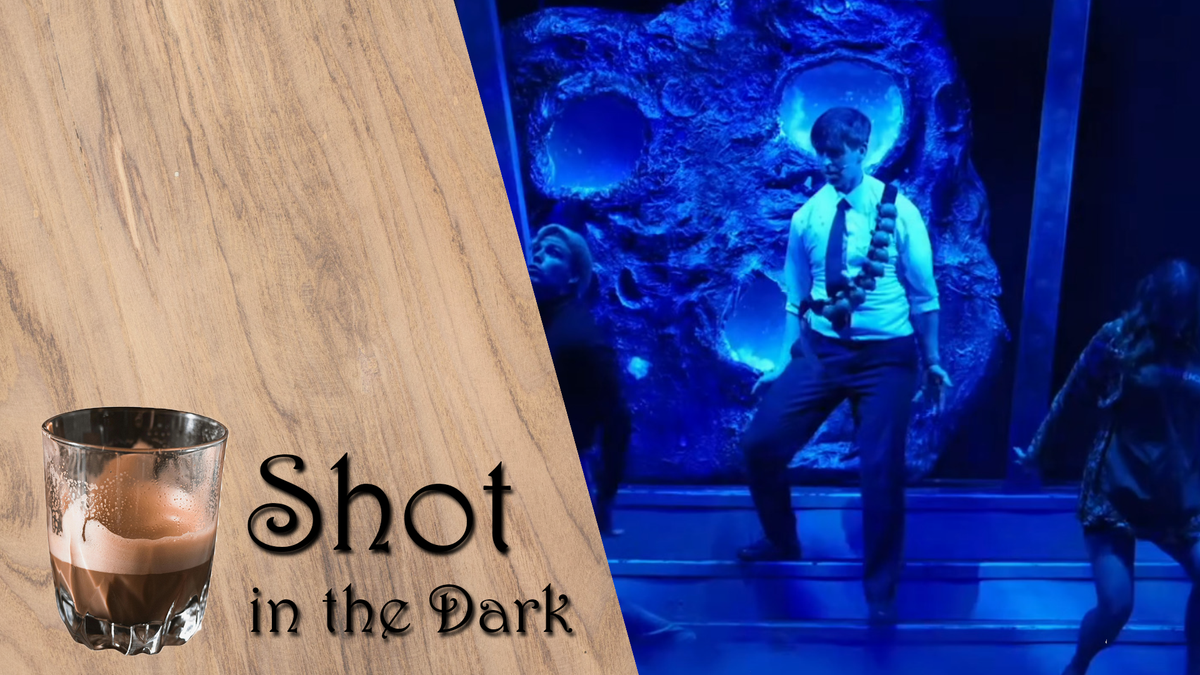
On an additional note, it's also neat to have the stage lighting itself reflect the blue that is associated with Pokotho, as well as the face of the meteor looming behind Paul as he is singing (mostly) his words to the other entities' tune.
Regarding the hive, while not quite visible in the pro-shot, it seems like they were sat down and watching Paul perform. Then again, as soon as Paul reappears centre stage and moves - as if to get up - the hive followed the call: they, too, get up.
Further showcasing how the lines between Paul, the infection within Paul, and the hive has blurred. This merging of not just the lyrics that had always called for the refusal of the apotheosis - even as it had been sung - but which now included a more distinct choreography; A call and response that kept switching between Paul, and the hive itself. Only separated, once more, after Paul regained enough of himself to finally pull the pin of the grenade. His final refusal, and an explosion left in its wake...
Personally, I'm of two minds regarding this.
For one, I love that we still get this focus on Paul; To see the amazing acting that Jon Matteson pulled of to showcase the duality going through him as he sings this song. Additionally, I'm a big fan of the vocals for this part. Always have been, but Jon's improvements and smaller changes simply took me away. What a joy to witness, really.
On the other hand - I still wish that we'd also had been given the chance to see the stage as a whole. The way everything had been coated in blue - and how the hive must have looked while looming in the background... I'm saddened by the fact that I could not witness it; And yet I can't fault the decision. This was meant to be Paul's time to shine... (And shine he did!)
Conclusion
Personally, I really liked how the new version had the hive be so proactive; And how the choreography had become more synchronised as a whole. Especially, as it leaned heavily on the side of mockery, as the hive simply adjusted their dance to keep Paul trapped within the choreography itself.
Then, as the hive takes hold, it becomes harder to sparse which moves were meant to be defiance and which moves were always simply their dance. As the apotheosis takes hold, they all reflect the other; They know the words - expect their moves - and Paul can no longer stop it;
And yet the hive still leaves Paul his solo. His number. He was their leading man for the end of humanity to come... and it was only fair that at a point where everything reached such high intensity - that Paul would be allowed to sing. This was still a musical...
However, all the praise for this new version aside, I can't help but also look back fondly on what we've had. A version of this song where Paul had been left flailing and had been forced to adapt to dancing while the hive simply watched him succumb. It is a different sort of apotheosis; A more lonely one, in a sense.
Though, it also felt more inherent to Paul and his character. He might have been infected, but he still was part of a singularity even as the spores took hold. A separation that he would be later denied.
The original was, in a sense, more comedic in tone. It focused on Paul's inherent lack of musicality. The new version focuses more on the implications of assimilation. The loss of self in favour of the hive; A pure moment of terror as Paul was dragged along, while simultaneously leading, this dance that he'd never wanted to participate in.