If I believed in wishes...
What is the difference between a request and a wish? An opinionated look at Silksong's introduction to its quest system and how it managed to enthral at least one player.

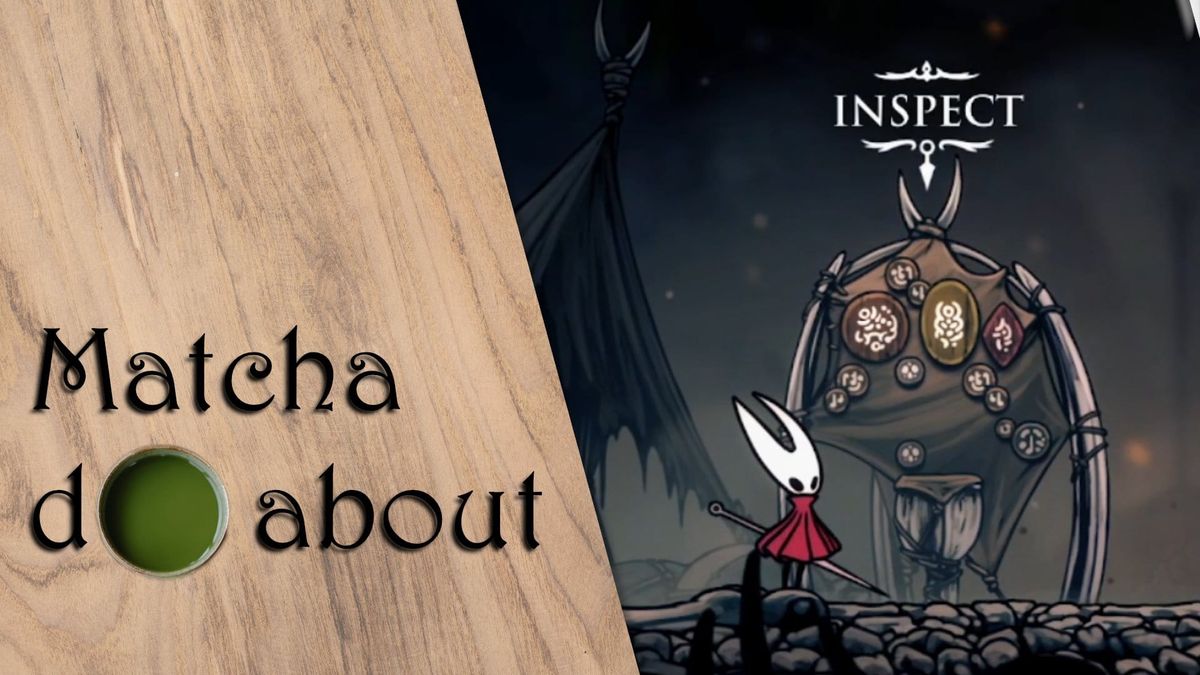
"What's this you're building, sir? A sign of some kind?"
"Aye, aye. You're a sharp bug! A wishwall. It's past time this old camp had one. As a resident fixer, I've taken it upon myself to sort it out.
They're a popular thing about Pharloom, wishwalls. Useful too. So many prayers left unanswered. Gives 'em a place to go"
(Hollow Knight: Silksong, from a conversation between Hornet and Flick the Fixer)
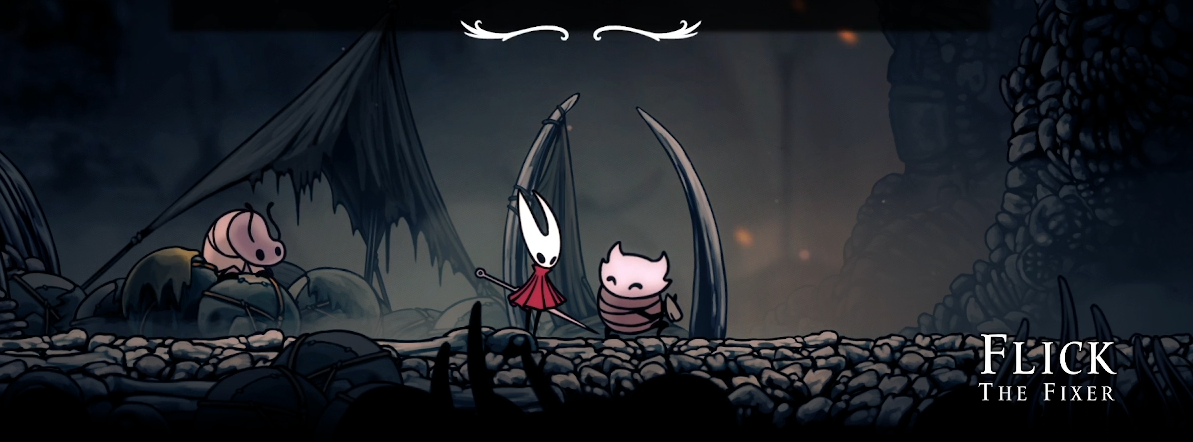
The concept of quests in video games is nothing new. They're such a common fixture in game design that most people with more than a passing familiarity in regard to video games won't bat an eye at the mention of a game's main or side quest, as it were. Though, they're not always directly referred to as quests. Other more common names are: objectives, missions, or requests. There are many names, and I don't tend to analyse them routinely - and yet I'm thinking about Silksong. A game that introduced its side quests as wishes.
In Jeff Howard's book Quests: Design, Theory, and History in Games and Narratives, the author summarises the early inclusions of quests in video games as a solution to a - fabled - conflict between "narratologists" and "ludologists":
"As an attempt at bridge-building between the open structure of games and the closed structure of stories, the concept of quests has been proposed by Ragnhild Tronstad (2001), Espen Aarseth (2004), and Susan Tosca (2003). Quests in games can actually provide an interesting type of bridge between game rules and game fiction in that the games can contain predefined sequences of events that the player then has to actualize or effect." (Jesper Juul in Howard.)
One important aspect of a quest being the element of interactivity with world the game provided. The concept was then further elaborated upon as follows:
"[A] player-avatar must move through a landscape in order to fulfill a goal while mastering a series of challenges. This phenomenon is called a quest." (Espen Aarseth in Howard)
In that sense, quests function as a motivation for the player to explore and can - thus - be considered the backbone of most video games. Their function being to provide the necessary hook to further engage with the digital world that the game itself provides. This encompasses both the larger plot - the main quest - and smaller side stories established throughout ones playtime.
However, if that structure and their presence is so common in story driven games, why was I so surprised to see a quest system introduced in Silksong?
The answer to that inquiry - to me at least - seems rather simple. Hollow Knight doesn't really start off with a straight forward quest; Nor does it really introduce a quest system throughout its runtime.
When I think about the start of the game, I tend to recall the Knight wandering to the edges of King's Pass before reaching Dirtmouth.
There the Knight can listen to Elderbug, an NPC who mentions that it's only him left in this tiny town; That every other resident had travelled further down where there had once been "a great kingdom beneath [...]. It's long fell to ruin, yet it still draws folks into its depths. Wealth, glory, enlightenment, that darkness seems to promise all things. I'm sure you too seek your dreams down there."
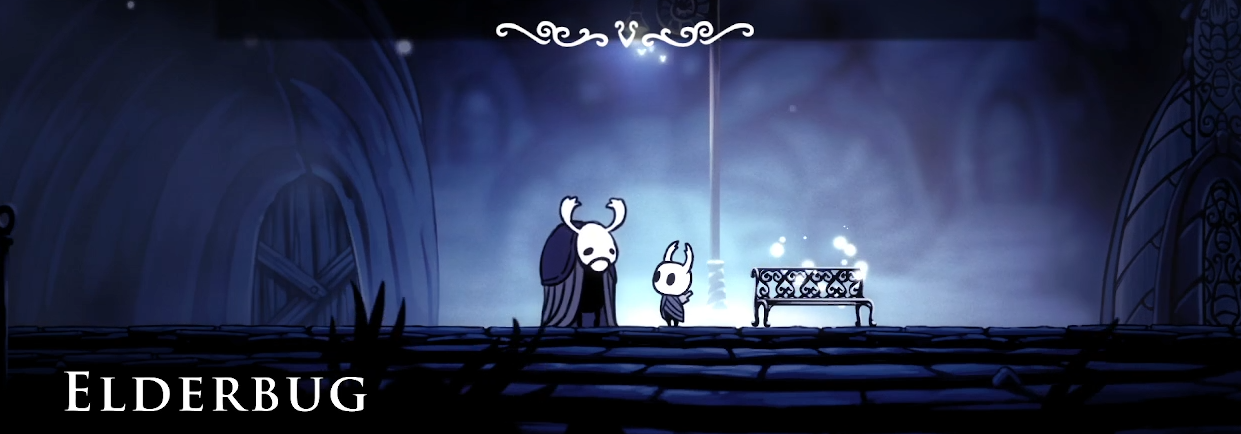
Thus, Elderbug is the one that suggests that the reason for the Knight's presence in this town was that call from beneath. However, there is nothing within the Knight's inventory that suggests as such. There is no dedicated quest menu. The player then can use Elderbug's suggestion as a jump of point. Apparently there is something down there - so this is the call to action, isn't it?
...well not quite.
People that have played the game know what I've previously omitted. The game's intro doesn't actually start with the Knight's arrival. Instead, it begins with the Elegy for Hallownest written by Monomon the Teacher:
In wilds beyond they speak your name with reverence and regret,
For none could tame our savage souls yet you the challenge met,
Under palest watch, you taught, we changed, base instincts were redeemed,
A world you gave to bug and beast as they had never dreamed.
The game won't elaborate on this, and this elegy is immediately followed up on with the introduction of the figure of the Hollow Knight, wrapped in chains and leaking infection, within the black egg. There is an audible roar before it fades to black - and that is when the player is introduced to the Knight bordering King's Pass.
Now, we do not know at that point if the Knight had heard of the Elegy of Hallownest, nor do we know if the Knight had been close enough to hear 'whatever' has screamed inside the black egg. Therefore, we can't quite argue that the Knight has a given quest on mind. However, for the player, all of these scenes - as well as Elderbug's introductory comments - are meant to provide a few invisible plothooks.
- Who is Monomon the Teacher?
- What is the deeper meaning behind the Elegy?
- Who/What screamed?
- Why did it scream?
- Who are we and why are we here?
Elderbug really did his best to suggest that we find the answers down below; What a friendly guy.
Now, while the Knight is traversing Hallownest there still isn't an immediate main goal apparent; Even though, Hornet seems to think that she knows what our quest might be.
There still isn't a clear directive present. It is only after some further exploration that the Knight will come across the Dreamer Shrine within Hallownest's Resting Grounds. There the inscription reads: "To protect the Vessel, the Dreamers lay sleeping. [...] Through their devotion, Hallownest lasts eternal."
At that point, the vessel will meet the Dreamers; Dreamers who - like Hornet before - recognise the vessel and make their assumptions regarding the quest that the Knight must be on:
What compels its climb out of the darkness? What compels its return to this sacred kingdom?
A call from beyond the Seals?
By the Vessel, or by that captive light?
Would the Seals break?
They cannot be undone.
But the Vessel weakens.
That plague springs anew.
They must be undone.
Yet still our Seals remain.
Our duty holds.
It must be cast away.
Our duty holds. It shall be done.
Sensing the danger in the Knight, the three Dreamers manifest, before using the last of their energy to pull it into the world of dream.
At this point, a few questions will have found some answers, and for most players this will be the turning point.
Fade away, little shadow.
Fade away, and let us sleep in peace.
Now, the Knight won't stay asleep. It'll receive some help by a Seer, and after that it is in possession of the Dream Nail. A weapon which can attack both the living and the dreaming, meaning that it could also attack the Dreamers. With all of these hints a trajectory becomes rather apparent for the player. Moreover, the map now indicates the location for each of those Dreamers thanks to that inscription on the shrine...
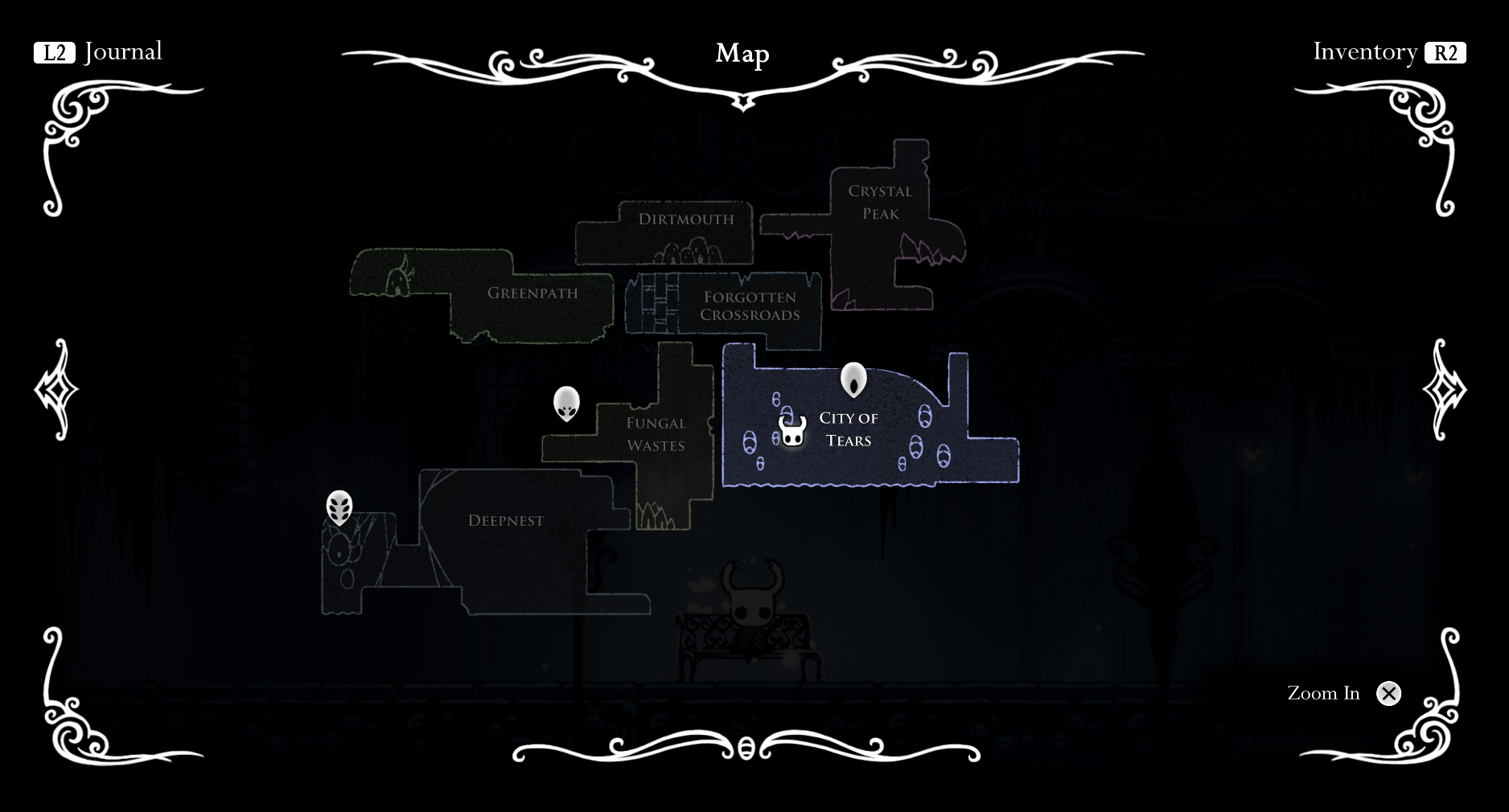
There might not be a 'given' quest, but most players by this point have set their goal. They understand that using the Dream Nail on each Dreamer will undo the Seal and open that mysterious egg. One might - or might not - know what that'll do, but with this a more direct goal has been set in motion.
Thus, Hollow Knight certainly provides the means for a player to guide them and to provide them with certain objectives. However, the game deliberately withholds the written quest. There are no lists or menus that keep track of them in any form. The Knight seems to have no clear objective; Though, by that point the player most likely does.
With all of that said, it shouldn't be too surprising that one might have assumed that Silksong would rely on a similar system; At least I'd been one of those that had assumed as such.
However, by now it is clear that this wouldn't be how the Hollow Knight franchise would operate at all.
They see your beauty, so frail and fine,
They see your peace, woven of faith and toil,
They forget your heart, bound in slumber and servitude,
When you wake they shall see your truth,
A best's nature bare to all.
- From "Pharloom's Folly" by the Conductor Romino
Silksong, too, starts with a reference to an in-universe text. So far, so similar. Thereafter, the game begins its intro cinematic where an already captured Hornet is carried an undetermined distance away from Hallownest and towards Pharloom. Those unknown assailants were nearing their destination, when Hornet had been given the chance to escape. Even in her weakened state she used the first opportunity to ruin their day; causing for the bridge to collapse and throwing them all down.
Where the Knight seemed to have either freely wandered - or had been called to - Hornet had been dragged to against her will. Where the Knight had seen a destination and moved towards it, Hornet had been too weak to fully notice her surroundings; But the moment she'd been given the chance she'd thrown herself away from their destination.
When Hornet wakes, she's at the bottom of the Moss Grotto, there she starts her climb up and comes across a Chapel Maid. Unlike the Knight, Hornet doesn't simple listen, instead she speaks.
"[...] My welcome to your land has not been kind. I had reason to be wary."
"So you're another pilgrim then? Scuttled out of the darkness to climb the great path and bow at its gilded peak?"
"I am no pilgrim. I am Hornet, and I arrive in your land by no choice of my own. I was brought to your kingdom by force, captured by strange bugs clad in veils."
"Oho! How curious! The bugs of the Citadel, at the summit of our land. They veil themselves in service to their faith, or perhaps as slaves to something greater..."
"Then I shall seek their Citadel. If the veiled bugs would go to such lengths to bring me here, I intend to find out why."
[...]
(Hollow Knight: Silksong, snippets of the introductory conversation between Hornet and the Chapel Maid)
The Chapel Maid gives Hornet a warning, this kingdom is dangerous and, thus, it be wise of her to keep her weapon close. The conversation ends, and the screen fades to black; A new objective is added.
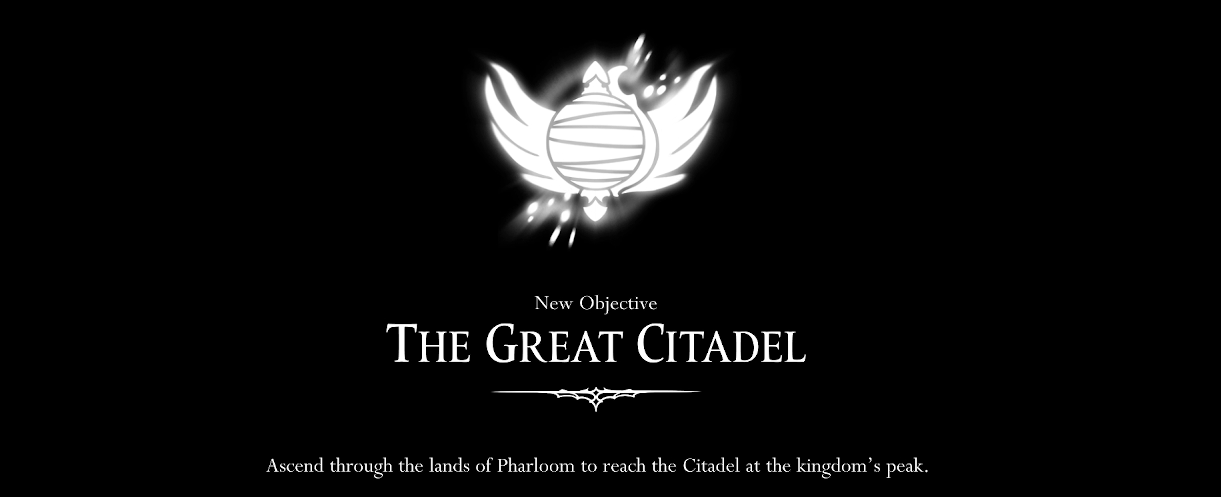
Truly, the introduction to Silksong - to me - balanced an interesting line between feeling so familiar and yet so different. It perfectly seems to encapsulate what this game would be - something that isn't like its predecessor.
In retrospect, these choices - to have Hornet speak, to have her actively pursue a main objective - are completely logical and lore compliant; And yet, as a player, I had found myself quite surprised.
There was nothing vague about this quest. Hornet knows what she wants to do and why; And she keeps track of it too - as the game has a dedicated Menu Screen for its 'Tasks'.
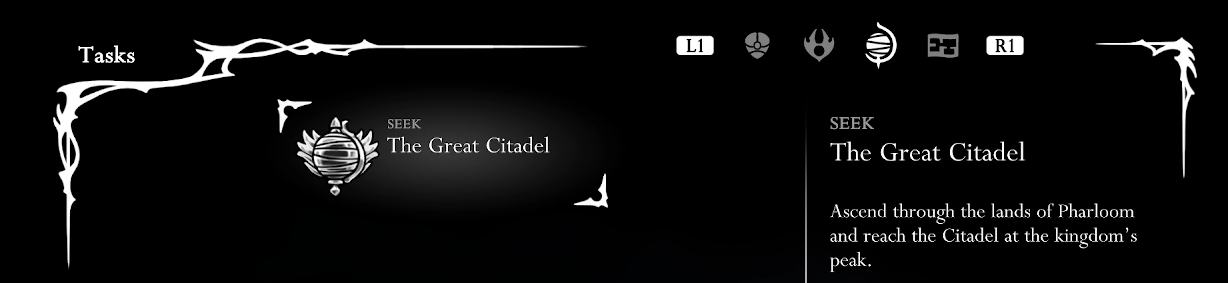
Now, for this specific article it's also important to distinguish. This quest that had been added, that had been an objective, not a wish.
So, then, what exactly are wishes?
The wishwall is introduced shortly after Hornet's conversation with the Chapel Maid. It doesn't take much time at all to go from the old chapel toward Bone Bottom - the last rest-stop before any pilgrim would start their pilgrimage.
There are only a few inhabitants currently staying in this settlement, and even fewer that Hornet can interact with: a lone pilgrim sitting by the fire, one fearful pilgrim that hid away in one of the buildings, a merchant that had set up temporary shop, and Flick the builder.
If Hornet speaks with Flick, then this will be the first introduction to the concept of a wish - as well as the wishwall - in Pharloom. There isn't much to say after, and the conversation ends after Flick's given explanation. Since there isn't much else to do, Hornet will leave the Settlement and begin her own journey towards the Citadel.
However, even if one hadn't spoken with Flick, there is another more direct introduction to wishes in Pharloom: The Moss Druid.
Early on, while one is exploring the Moss Grotto a sound cue can be heard that will guide many players to the hideout of the druid. Hornet is far more interested in the state of the Kingdom, as well as the potential presence of her ancestors in the land. Her inquiries are quickly pushed aside, though, in favour of the druid's own pressing concerns regarding Hornet's sudden appearance.
"Mm. Mmm! Who is it? An intruder! Terrible! To interrupt a humble druid as they work!"
"I mean no intrusion, druid. The sound of your laughter drew me to investigate.
This settlement is built around an old structure of the Weavers. Do you know of them? Do they inhabit this land still?"
"Mm? What settlement? What Weavers?! You speak nonsense!
You're here, in here, so why did they send you? Hm? Did you hear my wish? Granter of wishes? You?"
"Granter of wishes?"
"Wishes, yes! My wish! I need fruits of the world, three little darlings. I need them, so I wish! Does the kingdom not send you, little you, to grant my desire?"
(Hollow Knight: Silksong, from a conversation between the Moss Druid and Hornet)
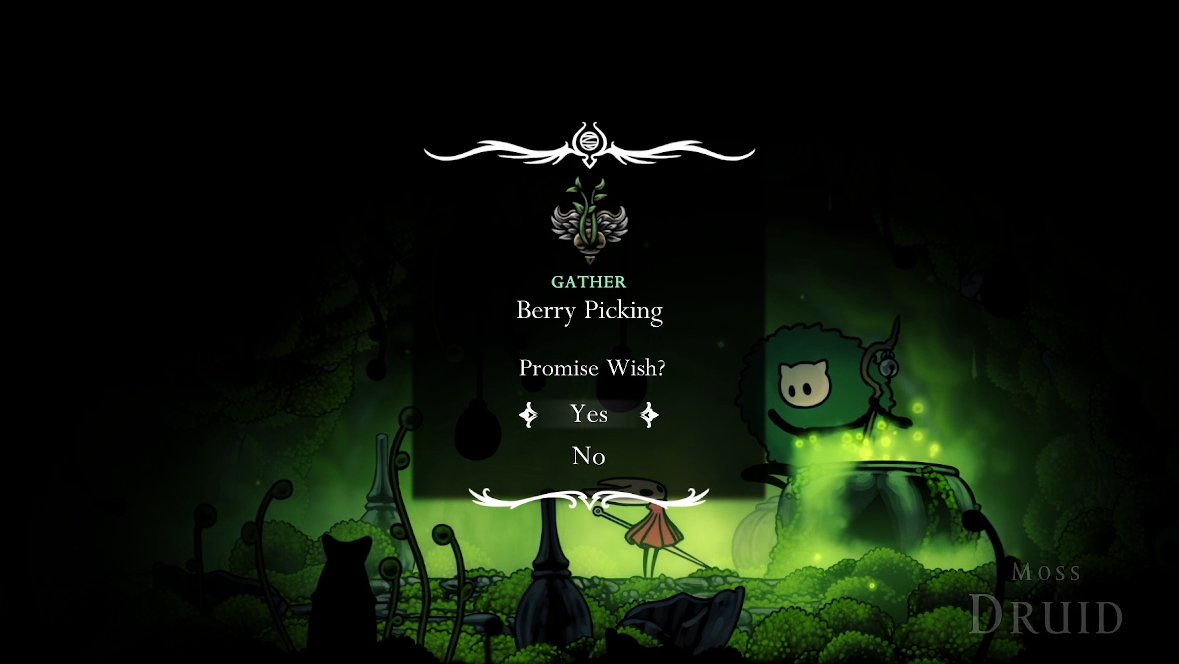
The conversation is then interrupted by the appearance of a choice window. The deliberate choice to either accept or reject; Once again, there is a certain difference in the ways these additional quests are given. Hornet promises to fulfil a wish, while the Knight pursues any quest passively. Hollow Knights most notorious sidequest is the delicate flower quest; But even there, the Knight is first given the flower without any active input. The Grey Mourner mentions the flower's fragile state and where to bring it, but there is no quest screen. Only if the flower breaks and the Knight returns, does a choice window even appear: "Accept the Gift".
No promise is ever made.
Hornet however, has the ability to truly decide. Even in these moments of player choice, the nature of their characters manages to persist. It's those UI elements that add to the immersion, and it's one of my favourite aspects for both games. In the same way as both Hornet and the Knight reaching into their pocket for their map to orient themselves.
What this means, however, that I found myself wondering about the value of a Promise; And as soon as Hornet agrees, the Moss Druid seems to provide an answer to that question:
"Promised, then. A binding stronger than sin. Bring me the three Mossberries. Precious fruit! Grant my wish, and then the work begins!"
This might simply be considered more flavour text, but at that moment it made all the difference to me. The Moss Druid was now expecting Hornet to return with those berries.
Somehow, this felt far more intimate than many other quests that I'd accepted in many other games.
The immersive way to weave in quests was nothing new, I've played enough games that ensured that quests would only appear in immersive ways. This game hadn't revolutionised the concept - And yet, it felt different to me.
For my playthrough, the Moss Druid actually didn't have to wait long. Hornet had already explored the surrounding area and had two out of three berries on hand. Thus, it hadn't taken much time at all to explore another previously unknown path to come across that third berry.
The game is actually kind enough to include a visual indicator when the requirements for a wish had been met. It hadn't taken Hornet more than two minutes to return to the druid's cave.
"As promised, druid, I have your berries. What is your need for such common fruits?"
"Common!? No. No... Special. Cherished. Only a druid knows it! The berries bright! For my wish. My wish so dear!"
[...]
"Mmm! Mmm! This is them, the precious, promised fruits!
Drop them in, there they go, and now at last we can begin!"
[...]
"You, wish promiser. Wish granter. You brought me what I needed and stayed by my side. Companion through my ordeal. I could ask for nothing more.
And for the parting, a gift. An amulet of we druids. Or me druid? No others, I think.
May it ease your sorrows, wish granter. May it cry for you when no tears are left!"
(Hollow Knight: Silksong, from a conversation between the Moss Druid and Hornet)
In a most likely case, this had been the first sidequest that the player would encounter - and, thus, the Moss Druid certainly didn't hold back on lore. Simply through this conversation we've managed to learn that:
- There is an expectation that it is the collective - the kingdom - that sends someone to grant a wish; Not the individual.
- The promise to grant a wish is binding in some form; It's not a choice taken on lightly in this place.
Additionally, for the player too, this had showcased an important aspect of wish granting; Done solely through the Moss Druid's gratitude: The implication of a reward after having done a good deed. With any sort of quest, there is an expectation of some positive outcome for the player for having spent their time on the matter. It is this exchange that reinforces this ideal - even if there hadn't been the mention of a reward, the player's time wouldn't be wasted.
Moreover, with the first reward being a potentially useful tool it incentivises the player to engage further with the system, as they could be the means to provide Hornet with better gear.
Which indicates that they are side quests in all but title.
But I couldn't let go. Wishes were different, weren't they?
At least to me, they're not quite compatible with other terms such as a request. Most quests in games tend to be requests: they're direct and geared towards a specific group. They ask for something to be done - and there is a certain assumption that those requests will be seen by the intended recipient and then fulfilled.
A wish on the other hand... Well, wishes seem far less tangible. They're directed at the nebulous Kingdom in hopes that something would come to pass.
For now, Hornet seemed to have explored enough, maybe it was time to return to Bone Bottom and to see how Flick's wishwall was doing.
This conversation reiterates what both the player and Hornet had already picked up from the talk with the Moss Druid. However, Flick's explanation provides a few additional details:
He, too, believes that most commonly 'the kingdom' would be the ones that were usually granting wishes. However, he adds that this is something that is more likely for "those truly devout"; He then acknowledges that they probably wouldn't be considered as such. Thus, their likelihood to have their wishes granted seems even lower; And yet he'd built the wall anyway; And yet he hopes that these wishes will first be heard - then promised - then granted.
With my mind occupied with thoughts about wishes and the apparent reliance on them within the kingdom of Pharloom, I'd found myself thinking about other famous instances that focus on the concept of wish-fulfilment. Another kingdom that is known to tell tales of wishes that do come true - the rather famous motto of the Disney brand, or the 'Magical Kingdom' as they called it:
"When you wish upon a star
Makes no difference who you are
Anything your heart desires
Will come to you
If your heart is in your dream
No request is too extreme
When you wish upon a star
As dreamers do"
- Cliff Edwards, When you Wish Upon a Star, Disney's Pinocchio (1940).
This notion to wish upon a higher power, to be heard in the their time of need, and to have those wishes granted. A fairytale tends to support these notions. Generally, many folktales or myths tend to argue that one needed but to be a good person to be heard.
It reflects Flick's own words regarding the way one's wishes would be granted. Those truly devout would be heard; and while Flick might have been unsure if those pilgrims that hadn't yet dared to go on their pilgrimage would be 'good enough' there is something quite earnest in his decision to build the wishwall nonetheless.
The reason I'd found myself reminiscing about those fairytales and Disney movies was simple; The way that Flick talked about his hopes and dreams - to me - implied a certain innocence and naiveté.
Through "Pharloom's Folly" and the conversation with the Moss Druid, two major elements became apparent: That the Weavers that once roamed the land had long since moved on, and that whatever higher power remained had a low likelihood to care about the pilgrim's fate, if the line "a beast's nature bare to all" was to be believed.
Even without Hornet having ever stepped into the Citadel, I'd already doubted that any of those prayers would ever be heard. Or if they had been heard, I couldn't imagine that the Citadel - or its beastly resident - actually cared.
Considering this train of thought had started with a comparison to Disney, I'd found myself reminiscing about the deconstruction of that wishful thinking. A more cynical approach, that attempted to remove this element of hope and inactivity in favour of action.
An interesting deconstruction of Disney and it's way of wish-fulfilment is the Musical "Twisted" by StarKid Productions, which had been released on Youtube in 2013. A parody of the Disney brand, the movie Aladdin (1992), and the musical Wicked (2003-Today) all at once.
If I believed in wishes
As silly as it seems
[...]
But wishes are dreams
And dreams are pretend
So science and reason
Win out in the end
- Starkid Productions, If I Believed, Twisted.
The show establishes early on that simply wishing for something to turn better does not work; That the idea of fairytales is to be discarded in favour of actually taking action to improve one's situation.
And yet, the story they use as a medium to argue this case is the one where a wish granting genie is a major plot.
One reason this Play game to mind was due to the similarities in setting when compared to Pharloom. It is the outsider perspective to refuse to believe in wishes, and outsider's point of view to argue for proactivity; But it is also the outsider that attempts to truly provide the aid that the kingdom needs.
Meanwhile, in Pharloom, the wishwall in Bone Bottom is now completed and Hornet can investigate it. There she finds three different wishes already pinned up:
"Bone Bottom Repairs" by Flick the Fixer: A lotta repairs to be done around here, but I need more materials! All I wish for is some shell shards so I can get to work. Not asking too much, am I? (Donation: 200 Shell Shards)
"The Lost Fleas" by Mooshka of the Flea Caravan: I am Mooshka, humble stranger to this land and master of the Flea Caravan! I wish for aid, that all fleas may travel safely together!
"Garb of the Pilgrim" by the Residents of Bone Bottom: Those mad, violent pilgrims who haunt the great path... we could make use of their shawls here in Bone Bottom. And felling them would surely be a mercy! (Reward: Rosary Necklace)
Out of these three, only one of the wishes offers an immediate reward. However, Hornet - and the player - have already learned that no visible reward doesn't have to mean anything.
There is no apparent limit to how many of these wishes can be promised at the same time. Hornet seems to even remove them from the board. For one, this allows her to have access to the details from the wish, while simultaneously hindering anyone else from fulfilling it. Hornet, in this case, treats this board like a standard quest board.
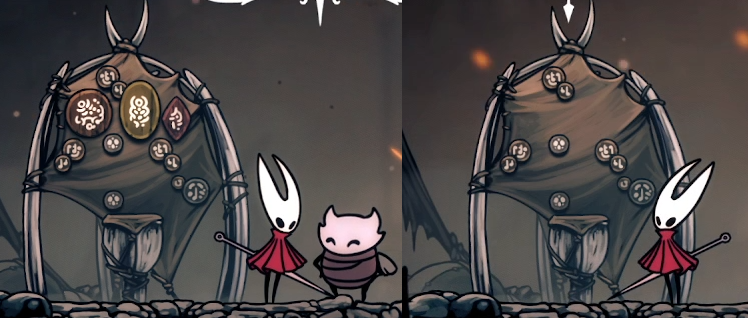
Since Flick remained where he'd been standing, it's rather quick for Hornet to talk to him after having donated the shells. It's an interesting conversation that the two share, as Flick seems surprised by Hornets good deeds.
"Well, look at that! You've gone and donated all those shell shards, just like I wished for! I can scarcely believe it!
Those shards are valuable, alright. Brilliant for crafting and fixing, very versatile. More than that, though.... it was a warm thing you did, the sort of kindness you don't see much in this weary place."
"Was this kindness? I must take care to learn of this land and claim what advantage I can from it. Answering requests like yours can often fit those ends."
"Oh, it's like that, is it? Well, even still, the help's well appreciated, miss. Best of luck in your travels, and may every wish of yours be granted!"
(Hollow Knight: Silksong, from a conversation between Flick the Fixer and Hornet)
Hornet regards these wishes as requests. Moreover, she refuses to categorise her acts as kindness. Her motivations are clear - she has a mission to accomplish and fulfilling the occasional request will aid her to reach her goal. No matter if the player had been motivated by a drive to help, Hornet had done so due to her belief that these actions will benefit her somehow. According to her, there was no altruism involved.
Flick seems surprised at first, but unbothered - the reason for Hornet's help doesn't matter considering her actions are providing support for the town.
This missable interaction is probably one of the more important ones to understand Hornet's character and her journey throughout the game. She's never been heartless, but she's always focused and goal oriented; And yet, donating the shards at this point in time did not yield a reward. There was potential, which she might have recognised, but it wasn't as certain or clear cut as her dialogue suggested.
Hornet's choice to call them requests in conversation was what cemented my own fascination with the terminology of it all even more. The game can treat wishes like quests, because Hornet treats them as such; At least the ones she gets to interact with.
Nevertheless, her self-proclaimed practical nature does not completely deny her compassion. Throughout her journey she will warn pilgrims of the dangers that are present on the path to the Citadel.
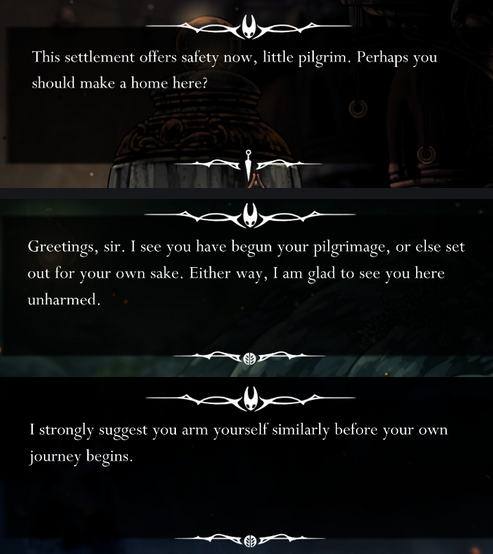
Her early conversation with Fleamaster Mooshka further destabilises Hornet's own argumentation for providing any support. Mooshka did not offer a reward, his travelling caravan simply asked for help - as he, too, had come to learn that wishes are a commonality in Pharloom.
For Hornet, her logic is as thus: she's already traversing and searching through the lands, there is no reason not to keep an eye out for any fleas all the while:
"Fleamaster, I took your request from the wishwall in the pilgrim camp. You are seeking fleas to join your caravan?"
"Oh, yes! The time has come for us fleas to find each other and travel together, as has happened through generations before.
The many fleas of this kingdom should be flocking to our caravan, but times have become dangerous. You feel it too, yes? Our poor cousins, out there, in hiding!
But... do I understand you rightly, stranger? You will help find the poor, lost fleas? Truly?"
"I am travelling these lands for my own reasons, Fleamaster. However, if I happen upon any fleas on my travels, I will aid them as best I can."
"Oh, oh, I could ask for nothing more! They must all be hiding or stuck in dangerous places, but if you rouse them they are sure to find their way here to us.
May the kingdom bless your travels and keep you safe, stranger! You are welcome to rest here with us whenever the roads bring you back!"
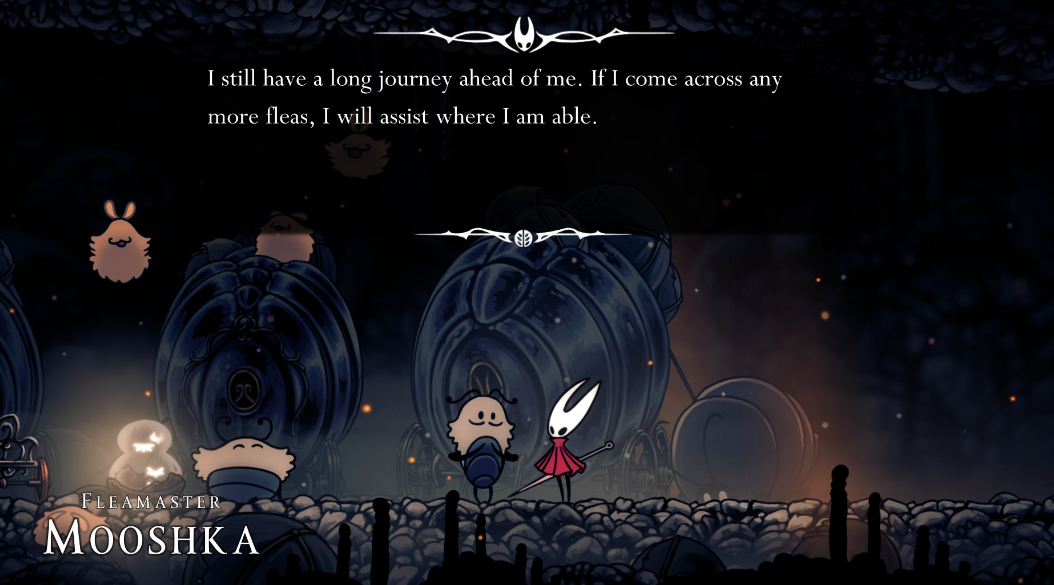
(Hollow Knight: Silksong, from a conversation between Hornet and Fleamaster Mooshka.)
The initial quest is completed after Hornet freed five fleas. Then she can talk to Mooshka once again, and already is it clear that there is more to Hornet's motivation than a simple reward: She likes the fleas. She wants them to travel safely, so she promises to keep an eye out still - even as the original wish had been granted.
Personally, I absolutely adored how Team Cherry implemented its quest system. Not just in the choice of word for it, but in the way Hornet in-universe ended up approaching these wishes.
During these early moments, Hornets promises seem far less binding than the Moss Druid had suggested. Yes, Hornet promised a wish, but her promise was conditional: it shall not hinder her main mission.
However, the more time Hornet spends with the people of Pharloom during her quest to climb the Citadel, the more she comes to care. When I indicated Hornet's compassion towards the other pilgrims, it is to note that these textboxes only appear when one chooses to interact with them.
What is a rather logical conclusion also means that there are playthroughs were Hornet can run through the kingdom of Pharloom without ever learning about wishes. Without ever making a promise, purely detached and goal-focused.
Hornet's compassion is not a given.
She'd long since been disillusioned of the wonders of hopes and dreams. She'd found herself relying on logic and practicality.
It is clear that Hornet, at least at the start of the game, does not believe in wishes; And yet she found herself in a place where its denizens still dared to hope and dream of something better. It goes against her own way of thinking, and yet she listens. She still considers their wishes, and she starts making promises...
...But there will be a point where Hornet will be ready to face what had ordered her captivity and brought her to this land; And at that point Hornet will have to decide if her own goal is worth the rush, or if she cares enough about the population of Pharloom to grant a few more wishes before the final climb.
Sources:
Cliff Edwards. “When You Wish Upon a Star.” Pinocchio (Original Motion Picture Soundtrack). Disney, 1940. Spotify app.
Hollow Knight. Written by Ari Gibson and William Pellen, Music by Christopher Larkin, Team Cherry, 2017. Multiplatform (ic. PC).
Hollow Knight: Silksong. Written by Ari Gibson and William Pellen, Music by Christopher Larkin, Team Cherry, 2025. Multiplatform (ic. PC).
Howard, Jeff. Quests: Design, Theory, and History in Games and Narratives, 2nd Edition, CRC Press, 2022.
Team Starkid. “If I Believed.” Twisted: The Untold Story of a Royal Vizier. Starkid Productions, 2013. Spotify app.