It's not a lake, it's an ocean.
Mischief has been diving deep into the lore of the Remedy Universe. This covers some elements of Alan Wake (2010), before recalling how they'd even ended up in this current position.

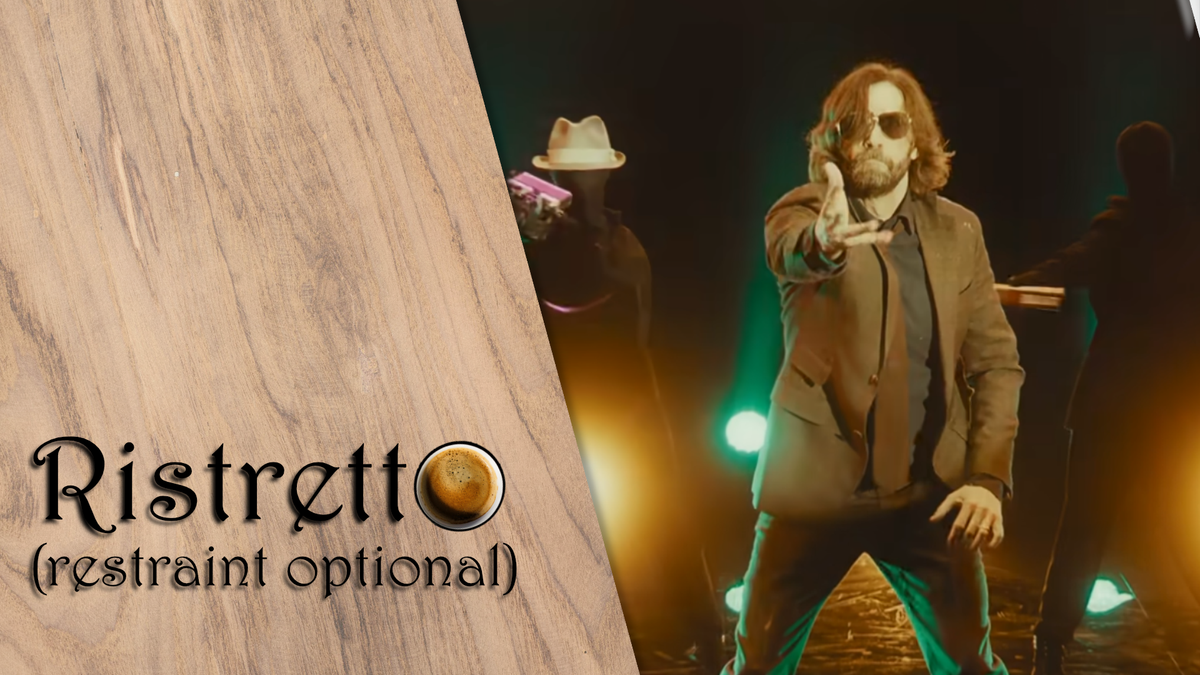
Not too long ago I'd finished Persona 3*, and while I had greatly enjoyed my time with it - I'd quickly found myself thinking about playing something that could be considered a "palate-cleanser" before (potentially) dipping into another larger RPG.
This decision led me down a rabbit hole and theory crafting session that - while still ongoing - I've been enjoying quite thoroughly.
It all started with a game that I've known for over a decade. A game that I've always loved, but also one that I hadn't played for myself until August this year.
Stephen King once wrote that “Nightmares exist outside of logic, and there’s little fun to be had in explanations; they’re antithetical to the poetry of fear.” In a horror story, the victim keeps asking “why?” But there can be no explanation, and there shouldn’t be one. The unanswered mystery is what stays with us the longest, and it’s what we’ll remember in the end. My name is Alan Wake. I’m a writer. (Alan Wake, in Alan Wake (2010))
Alan Wake had been one of those titles that I'd always wanted to play, but due to the fact that it'd been an XBox exclusive it never seemed to be a possibility for me. Our household had always leaned more towards the PlayStation, thus, I'd quickly realised that the only way to experience the story would have been one step removed: through watching a playthrough online.
Even then, I'd quickly fallen for the story's premise; A writer who - after a terrible incident - tries to save his wife, while he finds himself bound to a horror story that he had written.
It had been this meta-narrative layer that had fascinated a younger me. Not only, because I thought the gameplay concept in itself was intriguing, as it added incentive to the collectables themselves (due to their story and lore relevance), but also because narratively it opened up questions regarding one's agency.
The game asks many questions, and - to me, at least - it hadn't shied away from tackling its answers. Naturally, not everything had been given a direct answer; But generally I'd always been satisfied with the story the game had told.
Moreover, the gameplay looked interesting and fun; The concept of having to play an "unlikely" action hero had been appreciated. Alan's constant dash for safety due to resource management had seemed apt and offered an underdog story that a younger me had come to love from afar.
Though, if I'm completely honest: I'd say there were two main reasons why I had never forgotten Alan Wake.
Those two reasons are: Night Springs, and the Old Gods of Asgard. The former probably being the reason why I'd even ended up in this position.
...I hadn't been remembering an episode of The Twilight Zone. No, I recalled an episode of Night Springs; The fictional TV show introduced in Alan Wake (2010). More specifically, the very first episode one could find in game: "The Quantum Suicide". (Mischief, Tonight's Episode: "Funhouse Mirrors")
Having recently rewatched those episodes of Night Springs, I understand my previous confusion. The show itself presents itself rather similarly. Clearly it had not been hiding its inspiration at all: From its presentation (title-card and introductory monologue) to its narrative structure (a tale of horror, folly, and the weird in its many forms).
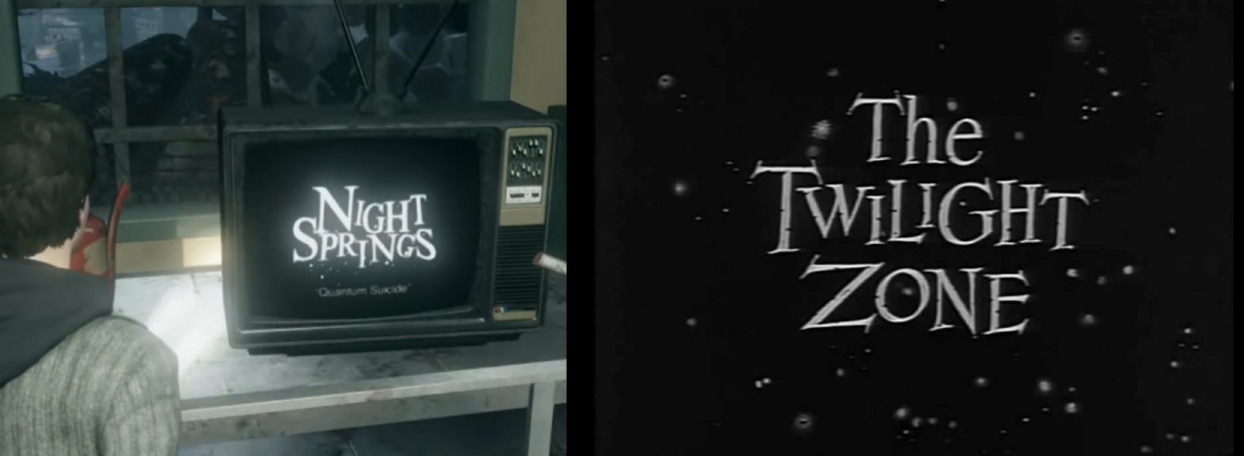
Then again, one more reason might have added to my personal confusion with those two shows. The fact that these skits used real actors over 3D animated models.
Night Springs wasn't the only thing that Alan could find during his travels through Bright Falls, but whatever was shown on the TV was usually shown in form of a live-action performance. Back in the day I'd assumed it was a deliberate form of separation from 'reality' as the TV world did not reflect the game world at all. Only as I grew older did it ever occur to me that this switch to live-action would also have simply provided Remedy with more freedom when creating their scenes.
Interestingly, Remedy Entertainment kept this intersection between live-action elements and in-game elements alive as time went on; And in some way I'd argue that it's probably one of their defining features - a feature that has long since become a favourite of mine. Well, those and their approach towards tension and release that asks the player for one thing only: their time.
There are many things that Remedy does to keep Alan in one spot. There are conversations, signs, radio interviews followed by a song, Alan's own inner monologue, and the TV interludes which can be separated in the "Writer in the Cabin"-Segments and Night Springs.
It's fascinating how Night Springs does not at all feel out of place, mostly because the show's own weirdness mirrors Alan's own evolving tale of horror; And yet that hadn't been enough. No, just like the people of Bright Falls love to mention Deerfest, so does Night Springs pop up in the general consensus. Not only that, but as the story unfolds, the player is made aware of an additional tie-in between Alan's past as a writer and the show that he's been catching glimpses of:
„Wow, Night Springs! Man, brings back memories. Hey, remember when I got you that gig? Your first real writing job, what got you started! Oh, is this one of your episodes? “ (Barry, in Alan Wake, The Truth)
This leads me to the other memorable part that had endeared Alan Wake to me back in 2010. The story itself was a story about creating art; Art of any kind and the power that this could have (both positive and negative).
There's a reason "My name is Alan Wake. I'm a writer" matters so much.
Even as he's been suffering his writers block, even as his work has been tampered with and misused; Even as time moved on, years passed by, with him still remaining trapped in the Dark Place... he is still trying to write his way out. It's what he does. No matter how many times the Dark Place tries to diminish his work, no matter how many times Alan ended up doubting himself - he keeps writing.
Though, while we mostly experience the trap that lies underneath this lake as Alan, he's not the only one that had fallen under its thrall. He hadn't been the first to wake the Darkness...
At the start of the journey, Alan meets quite a few characters. From Pat Maine, the radio host that one can hear reporting about Deerfest, to Rose the waitress at the Oh Deer Diner, who is quite the fan of Alan Wake's work. At that very diner, Alan also meets both Tor and Odin, a pair of old men who apparently had been rockers in their past: The Old Gods of Asgard.
Though, now they're considered past their prime. They're memorable; While their fame had only been hinted at, it fosters a certain connection and understanding between creators. Especially, when Alan realises that the force that had twisted his own work, had done similarly to the brother’s rock music.
And yet, back in 2010, nothing had prepared me for the fact that the player could actually experience a track of their old hits.
In the game’s 4th chapter „The Truth“, Alan was told by the brothers to visit their old farm. That they had a message for him there. With the new goal in mind, this turns into the chapter’s main goal. While on his way to the place, Alan has the chance to pick up more of his manuscript pages, which cover parts of the Anderson’s past (including the fact that their moonshine consisted of mostly pure lakewater) as well as a description of Alan coming across the Anderson’s personal stage, which is just a bit to the side of their house.
For anyone that has played this game, the stage would most likely be the most memorable section of the game. Just as the player might think that they’re about to be overrun by the enemies – without enough light to fight them – a lightning hits the stage. This then causes for everything to come to life and with Alan ends up fighting hordes of enemies on this stage – all the while one of their „old“ tracks is playing: Children of the Elder God.
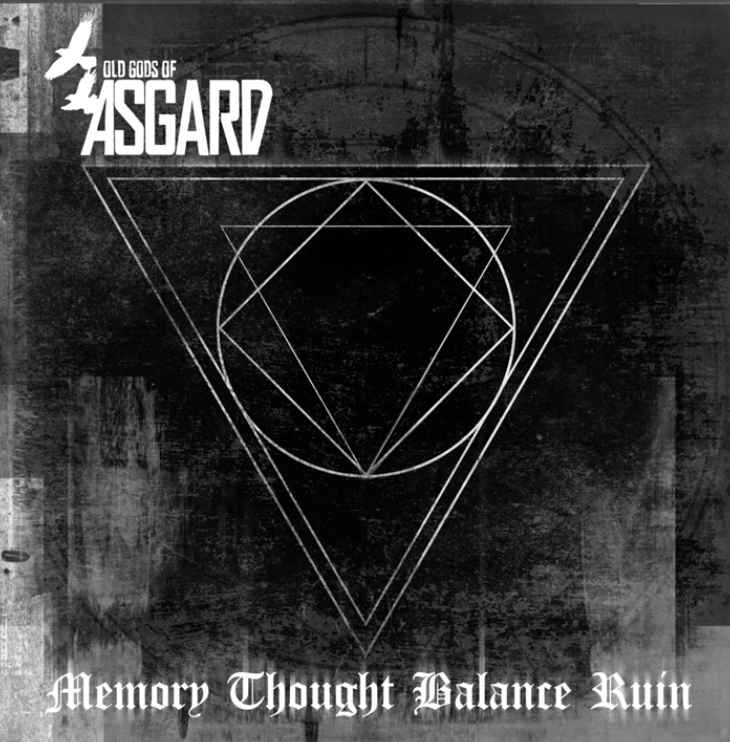
While the sequence itself was already great, it’s the realisation how the lyrics of the song and the events unfolding are working together. It is also the fact that these songs that had been recorded (in universe) decades ago, now ring true that further the themes of fiction and artistry having certain powers to shape and be shaped.
The Anderson’s themselves admitted that their music had stirred what had once been quiet, and Alan realises that he had unintentionally been the one to release it from its prison; And yet, the Andersons still offer information through their music.
After the spectacular scene at the farmstage, Alan finds himself searching through the house. There, he comes across another record: „Poet and the Muse.“ This song, even more so than their previous, gives Alan the information that he needed to continue in his quest: „Now to see your love set free, you need the witche’s cabin key. Find the lady of the light, gone mad with the night that’s how you reshape destiny“.
I’d argue that The poet and the muse covers two stories simultaneously. This isn’t wide of a leap to make considering the lyrics themselves name-drop „Tom“ as the poet in the song itself. In this case, the unnamed muse in question would be Barbara Jagger. Each verse elaborates on the happenings of the past – the happenings on Diver’s Isle in the 1970s.
The chorus, however, functions differently. It indicates the passage of time with the „now“ – an acknowledgement that the past caused for the events of the present to take place while also offering Alan the information that he needs to save his own ‘muse’ from the bottom of the lake…
The fact that the Player actually had the means to listen to the Old Gods of Asgard felt truly special; And yet, they weren't the only musical accompaniment that Alan Wake would receive. Through the radio, as well as at the end of an "Episode" of the game, there would be a song interlude. These song interludes had always been appreciated, and when I saw them reappear in Alan Wake II (2023) I couldn't help but release a sigh of relief.
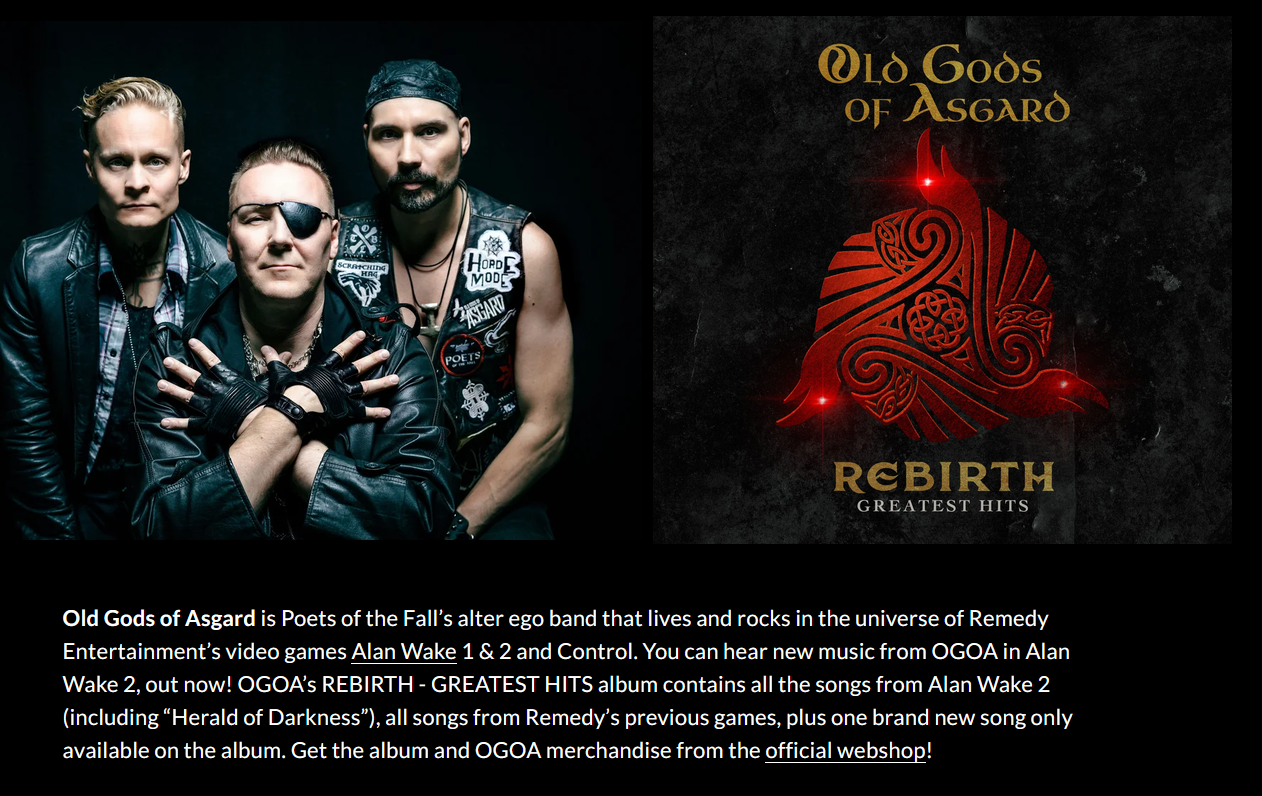
Now, in Alan Wake (2010) one of the songs being played on the radio was "War" by "Poets of the Fall", which Pat so succinctly introduced like this:
And here’s a new song from a band that—they always remind me of our local rock legends, the Old Gods. I couldn’t tell you why, I guess it’s just—you know, one of those things. Anyway, here’s Poets of the Fall and their latest single, “War”.
It was one of these moments that had actually taken me by surprise while I'd been playing the Remake not too long ago. It's funny.
A part of me had known for years that "Poets of the Fall" were the band behind the "Old Gods of Asgard". It's one of the things one will notice if they dive deeper into the music behind the game - which I'd done back in 2010 - and yet I'd never recalled how both bands had existed within the Alan Wake universe. Nor how one of their songs had kept its ties to Alan Wake all along.
Originally, I recalled the way the story kept me hooked all the way through. How, narratively, I was truly engaged with the events happening and the uncovering of the supernatural elements that were haunting the town of Bright Falls.
In the end, I had been rooting for Alan. He was a flawed man, but one that I truly came to like. A part of me had hoped for his success; Had disregarded the fears that a horror narrative would bring with it - the potential lack of a happy ending.
Then again, this was a video game. How could a game end in a player's "loss"?
Well, in a sense, I was correct. The end wasn't happy. It was bittersweet. Successes were had, but Alan said it best himself. There needed to be balance for it to work; Thus, he did his best to even the scales. To offer a fair trade for the safety of Alice Wake.
Only to follow it up with one last hook for the future. The idea that Alan might still be able to write himself out. Because that's what he does.
His name is Alan Wake. He's a writer.
I'd known immediately that if there ever were a sequel to the game that I'd be playing it. That it would be the greatest thing - and then just a few years later my hopes were dashed.
When Quantum Break was revealed at E3 in 2013, I thought it looked alright but was not part of any games I'd typically play. There were no big emotions tied to it - until I noticed that the focus on this game meant that the story of Alan Wake would be set aside for a while; When it became clear that Microsoft simply hadn't been interested in the sequel the same way as the people of Remedy had been.
The video Remedy released just after "Quantum Break" (2016) was announced.
Only then did I realise how much this saddened me. While I had no ill-will against their other projects, it was rather clear to me that Alan Wake was the exception, not the rule, regarding my interest in the studio's work.
This wasn't to say that I'd completely ignored the release of Quantum Break. Just like with Alan Wake - considering they were still XBox exclusives - I'd started watching other people play the game. Though, I'd lost my interest rather quickly. For one, I wasn't too big into the science fiction aspects around that time, nor had people playing the game recorded the TV show that had come with it.
I will say that - in theory - I think Remedy could have pulled it off. Yes, Microsoft and XBox had really been looking into this concept of merging "TV and Gaming" into some form; And Remedy Studios seemed perfect for a project like that considering their love for interconnectivity and passion for all mediums.
Since then, I've heard enough people complain about the issues with Quantum Break's 'TV show' that I cannot claim success, only that Remedy had tried their best with what they were given often leading to mixed feelings.
What I'd been interested in were the Easter Eggs; All those elements that indicated that Remedy had not forgotten Alan. It might have been simply fan-service, but I'd loved it. I loved it even as they led me to question if those worlds were actually more connected than previously assumed.
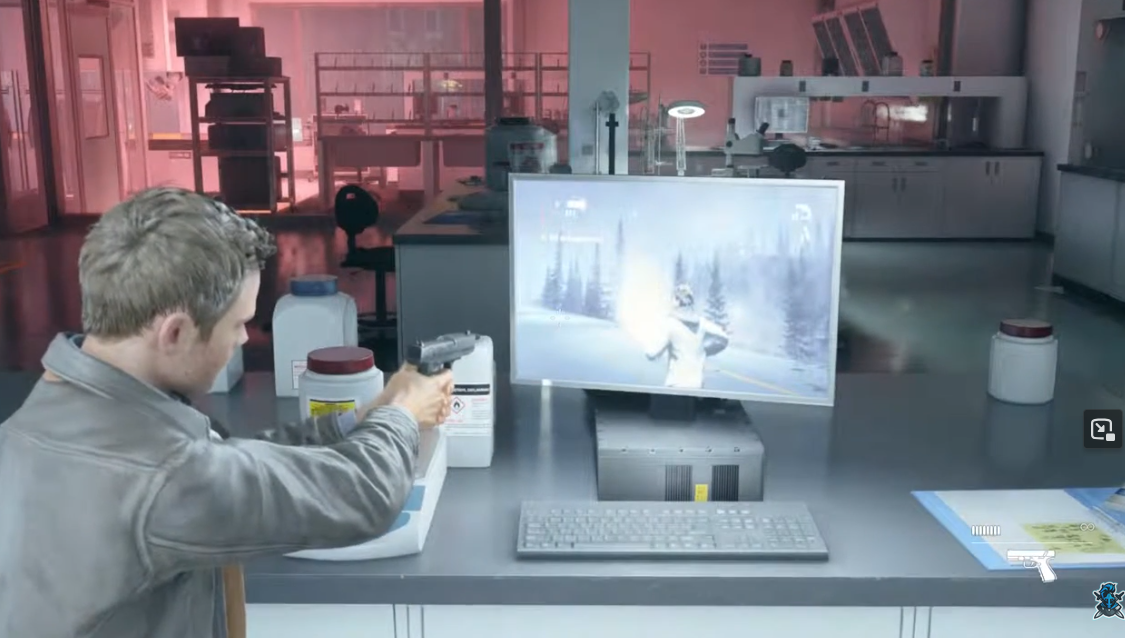
While many nods to the original game hinted at it being fiction in some form, not all of them did. The in-game screenshot and the plot analysis board at the university were one thing; But the presence of "The Sudden Stop", Alan Wake's last published book, the fact that Night Springs as a show still existed, and the fact that the band "Stonecrow" claims to be a tribute band to the Old Gods of Asgard.
It was only in 2016, when I'd learned that not only did Alan Wake (2010) include DLC stories that I'd never seen, but that there also had been another title released in between: Alan Wake: American Nightmare (2012).
The reason I'd never looked for them had been simple - I'd already given up hope on the game's sequel. I'd moved on.
Then Remedy announced Control at E3 2018. It leaned into horror, it looked surreal. It looked.... a bit too much like a shooter for me.
Once again, I was happy for them - a new game - no longer an exclusive title even from a studio that I'd always sort of appreciated for their passion; Even as I'd not played any of their games myself. However, with Remedy no longer being partnered with Microsoft directly, my hopes for Alan Wake II dwindled further.
Control (2019) had been a success. And then the news appeared that Remedy had actually purchased the rights for the IP of Alan Wake; Which gave new light to the idea that we'd see more of Alan Wake.
And we did. Control did not only include Easter Eggs to Alan Wake, but it fused those universes together. While Quantum Break had hinted at it, Control fully admitted to it.
It was something of a shock. I was excited! I was ready! And then - silence. Alan Wake's Remaster had been announced. It'd been quick in line to play it - the game I'd loved for years finally playable - only to realise that... like I'd always thought; The gun play wasn't really up my alley. I dropped the game, not disappointed with it, but disappointed with myself for not being able to get through it.
Then the unthinkable happened. Alan Wake II was real. Fire and Passion re-ignited after years - only to be doused by the memory of my personal failure. I wanted to know how the story would end; And yet... I wanted to experience it myself. When the game was released in 2023, I did not immediately buy it, nor did I watch anyone play it. I remained in the dark, happy for its success, but too afraid to get spoiled. Decision paralysis.
A survival horror game...
I never really played horror games. I still wanted to play Alan Wake II.
It took until this year for me to even try.
When I talked about The Twilight Zone, when I was reminiscing about Alan Wake (2010), I realised that I could try again. That there was nobody to explain myself to. That I could simply play and see if I liked it. That I didn't have to play on "Normal" but "Easy" if I wanted to get through with fewer issues regarding the combat. That playing it and experiencing it was enough.
Thus, I did.
I loved the Alan Wake Remaster. I loved to finally have the ability to remain still, to explore, and to simply soak in the atmosphere of the game I'd loved for so long. To experience all those moments that I'd always loved.
...and to finally play through the DLC that had evaded me. I'd loved every second of it - and I knew - I'd be playing Alan Wake II.
I'd still been unsure about Control, but I'd known that I'd be playing that sequel I'd been waiting for so long.
And little had I known that my re-ignited interest in the Remedy Universe had quickly aligned with the soon to be release of Control Resonant (2026). Which led to me getting both a copy of Alan Wake II and Control Ultimate Edition due to their sale.
My trajectory was set. First the DLC, then Control, then Alan Wake II. I didn't really care too much about Control Resonant, because - admittedly - I hadn't heard too much about Control post release.
...Since then I've played the first game and the sequel certainly has made it onto my wishlist.
Control (2019) is a fascinating game. It offers so much lore regarding the Universe that Remedy had been building for years - and the way the oldest house was utilised was fascinating. However, I admit, that part of my love for control also came from the way they handled Alan Wake.
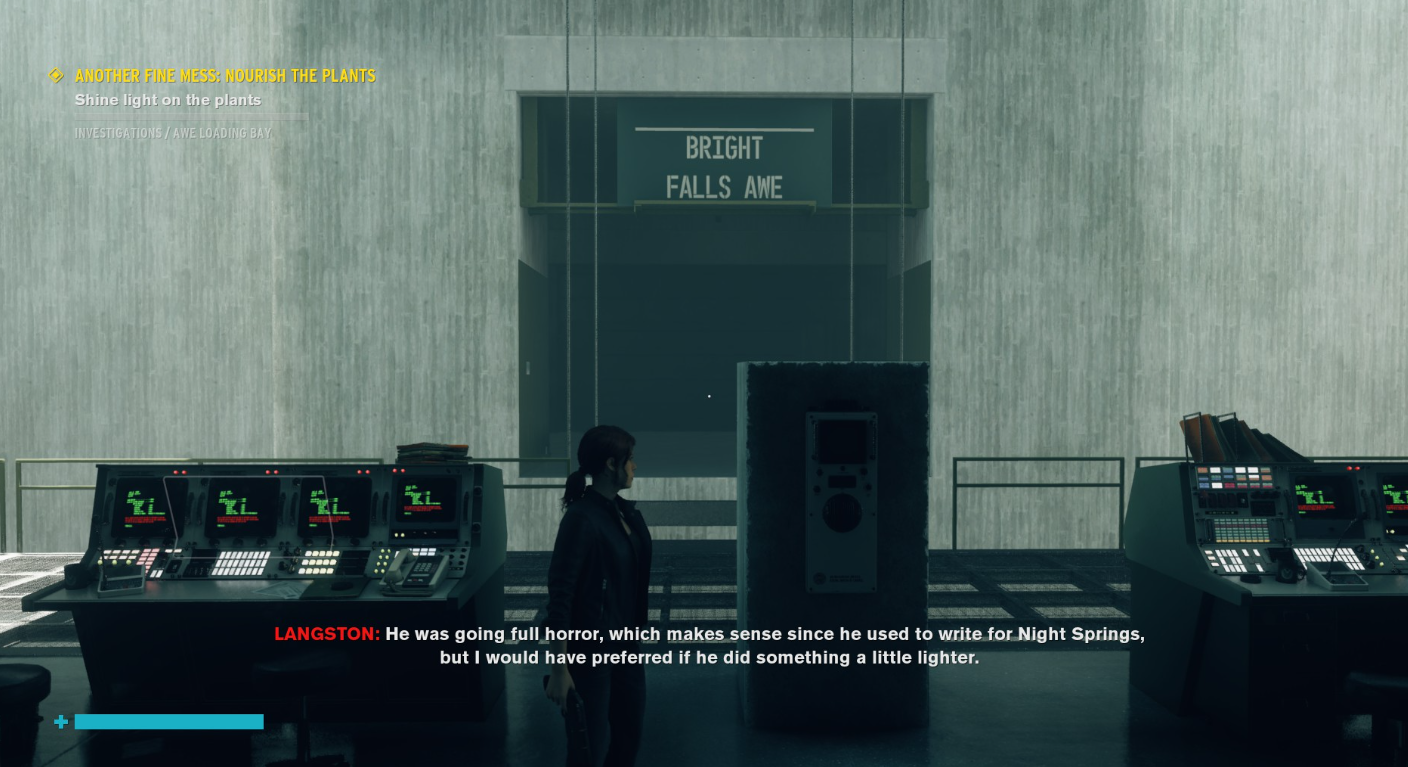
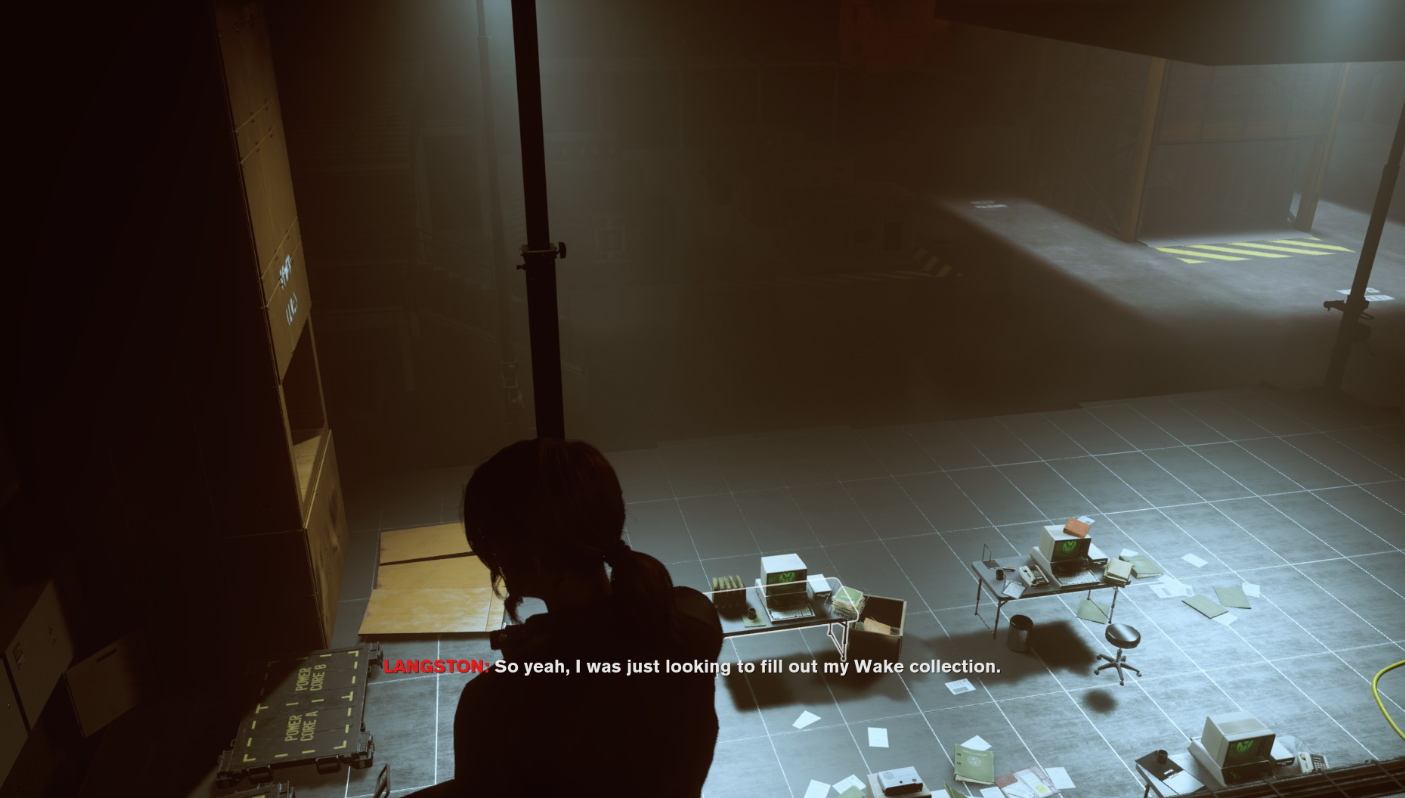
From hints and nods to the events post game, to a more direct inclusion in the game's DLC. Alan Wake's presence is felt, but never overbearing. Its inclusion logical instead of forced. It's amazingly done and had me on the edge of my seat as I'd been playing through the game.
They also set up a few things about Thomas Zane the Poet (maybe filmmaker) that I've yet to uncover - as I've not yet finished my own journey through Alan Wake II.
Nevertheless, I am fascinated with how Remedy managed to connect those two worlds without making it feel overbearing.
Admittedly, the game was leaning too heavily into a shooter for my tastes, which took some time to get used to; But it was an experience that I nonetheless came to appreciate and adore. Because I realised by this point that it hadn't just been Alan Wake's narrative that I'd come to enjoy, but the way Remedy built their world. Not just the ability to slow down, not just the fact that these places truly felt like places, but because I could feel the passion poured into every instance of it.
There is an internal logic present in a world that's so convoluted, so surreal and fascinating, and yet it's there. I could spend hours theory crafting; And since I've been playing Alan Wake II this time had only increased.
The most fascinating element and ability of Remedy Studios is that they got me to care. Not just about Alan, but about everything. This year alone, I'd been going through all the additional Alan Wake material, I'd finally looked deeper into Quantum Break and its TV-Show, I'd tried to find as much lore as possible while wandering the oldest house... I'd been having a great time.
By now, the idea that I'd been considering not playing through Control Resonant feels weirdly off-putting. Naturally, I'd be playing that game - I want to know how the story continued; I want to know more about all of it – but first: Alan Wake II.
This journey had been weirdly nostalgic, even as only the tiniest percentage of it had been known by me; And yet, hearing more about the Old Gods of Asgard, Night Springs, Bright Falls, and the general connection between those 'Altered Word Events' and 'Object of Powers' have caused quite a few theories. I adore that the Remedy Universe keeps me on my toes; Keeps me thinking and theorising as I play through their games.
Moreover, I feel rewarded for having taken the time to do so. Those games offer you the chance to dive as deep as you want - and I've been diving since I'd seen Alan Wake jump into the lake back in 2010. (And just like Alan, I still have to resurface.)