Looking at the stars; Looking for meaning.
Space hasn't just been on Sherigan's mind recently. I, too, have had my attention turned to the stars; Though, thanks to Andy Weir, I can't quite decide how I feel about them.


On a day like any other - just a few weeks ago - I'd been browsing YouTube’s subscription tab when one video had managed to catch my eye. It had been posted by Jessie Earl, aka Jessie Gender, on her second channel titled: “Andy Weir, The Critical Drinker, and the Culture War Machine”.
I recall stopping the scroll and re-reading the title. At this point I tried to remember why the name Andy Weir seemed familiar, but I couldn't quite place it. Then, instead of actually watching the video I'd moved on.
Sometimes it'll be those tiny moments that will cause the largest ripples; Even though, I hadn't actually watched the video, I was now primed to notice Andy Weir's name: a great example of the Baader-Meinhof phenomenon at work. Suddenly, I couldn't unsee the (not so) subtle presence of Andy Weir's work on my social feed!
Apparently, there had been this movie - Project Hail Mary - that people really seemed to enjoy? It had been release mid-March and was based on Weir's novel of the same name?
This additional context was all that I needed to finally be able to connect the dots. I might not have known about Project Hail Mary, but I had been familiar with adaptations based on Weir's work before: I had seen The Martian back in 2015, and I had enjoyed it enough that I'd put the book onto my 'to-read' list.
Not that I ended up reading it, though...
My curiosity was piqued, and yet I found myself to be of two minds. All those positive emotions were weighing against the memory of that condemning video title. Additionally, it seemed that even in the fandom spaces for Project Hail Mary, people were talking about Andy Weir's statements regarding his own work.
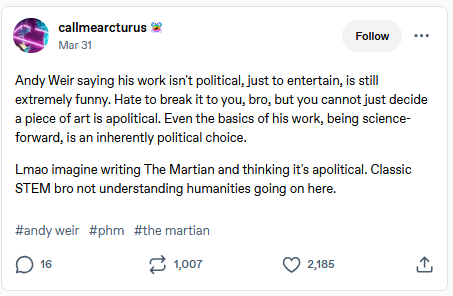
Clearly, there was more going on - and by this point I was very intrigued. These posts were all referring to some specific facts; I simply had to know if - and when - Andy Weir had made these comments. My interest in Project Hail Mary itself was being drowned out by my interest in this apparent discussion about the intention and meaning of a work.
Not that the praise for the movie - nor for the novel - had stopped in these spaces. However, I did not interact with those as often, as I still hadn't quite decided if I wanted to watch this movie or not.
In the end, it wasn't really hard to find one of the actual statements that people were referring to. In an interview with Futurism in 2017 Andy Weir said:
“I put no politics or social commentary into my stories at all. Anyone who thinks they see something like that is reading it in on their own. I have no point to make, and I’m not trying to affect the reader’s opinion on anything. My sole job is to entertain, and I stick to that.”
Weir claims that what defines his text is mostly what he'd intended for it to be; And that his take is the correct answer. Any Interpretation by "anyone who thinks they see something like that [politics or social commentary]" is, according to Weir, seen as an incorrect reading of his work.
If I hadn't been so disappointed by an author saying something like that, I'd been laughing loudly. It's moments like these were I recall those early literature and textual analysis classes the most. To quickly quote the introductory chapter of my old course book, Textual Analysis - Textbook by Elisabeth Bronfen:
[...] [L]iterary texts are characterized and defined by a surplus: by ambiguity, ambivalence and multiple meaning. We cannot isolate one single truth hidden behind a veil; we need to get away from the idea of a single author's intention (4-5)".
There really was a lot more that could be said, but I hadn't been in the mood to start my own little tirade just because an author was unaware of the fact that any writing will reflect the author's cultural landscape - be it traditions or expectations - even if there were no deliberate nor 'grandiose' statements at the end.
My curiosity had been satisfied, this had been my chance to move on from the topic and to never look back.
And I'd actually tried, but my social feed didn't quite receive that memo.
Discussions about the movie persisted, which meant they were still occasionally filling my dashboard. With its persistence I felt my curiosity reignite. What was it about this movie that had people so entranced?
Thus, when I'd actually been approached and given the chance to check the film out for real - how could I say no?
But that part of me that had been so frustrated before kept nagging at me, asking near sarcastically: What sort of story does one tell who wishes to 'only' entertain?
Project Hail Mary (2026|Lord & Miller|USA)
...Apparently, it's a story about humanity. More specifically, a story about humanity in crisis.
It's a story about co-operation, communication, and sacrifice. A story that poses questions such as: “What would you do to save the world? What would humanity do to try and save the world?”
It probably won't be a surprise for most that a story that wishes to answer a question like this is not bereft of any symbols or meaning.
The most obvious being on the title card itself: The project to save humanity is called Project Hail Mary. A last ditch effort, true, but the connotations behind the term - its catholic roots as a last prayer to god - being accepted by a group of people from all around the world. Though, to be fair: If the world truly was in crisis, naming the project might not have been the main issue.
More generally, the movie suggests that humanity would try and solve this issue; that humanity would be able to band together well enough for this last hurrah. This story that was meant to entertain tells us that humanity would co-operate, and that humanity would trust its scientists to find a solution.
On the part of the individual, the story that is being told is a story about hope and about friendship. When one human is left aeons removed from the planet Earth in search for the cure that this person could bridge the gap between species - and that a positive connection can be formed. This story suggests communication over wars.
No symbols or meanings, apparently. Don't mind me.
None of that was what had won me over.
I'd known before I watched this movie that there had to be something in the story to actually grab people's attention - and hope certainly does.
What sold this movie to me, and is the reason for this whole article, was the visual marvel that it offered to me. This movie looked stunning. They focused on real sets, and used as many practical effects as possible with the CGI being used sparingly, but effectively.
Personally, that's the reason I wanted to recommend this movie.
It is also what manages to tell this tale of friendship so well. The alien species, a 'giant space spider' made out of rocks hadn't just been computer generated, but they'd used some actual puppetry to make the character feel so alive. Though, it would have been a nicer experience for me if it hadn't moved like a spider.
I think the reason I wasn't as sold on this story like many others was a simple one: The movie simplified the scientific aspects of itself and then decided to cover those holes with either action or humour. Science was meant to be the solution, and yet so much of it seemed to have been glossed over.
As a consequence of that choice the character of Ryland Grace felt less like an actual scientist to me; Instead he'd felt like more of an 'Everyman'-type of character as the movie went on.
The movie might tell you that Grace was a smart man, but he really hadn't felt that different from many other characters that I'd seen depicted on screen.
Another tiny, but personal, gripe was the way they'd handled the linguistic aspects in the movie. There were two completely different species that had to communicate to solve their problem. The movie - to me - seemed like it couldn't delegate enough time to cover the intricacies of language acquisition.
I still had no wish to engage with this project on a deeper level, but my gripes with the movie led to a new question: how did the book compare?
My frustrations that started all of this were kept buried for now. There was no reason to let Weir's statements destroy the tiny bit of enjoyment that I'd found in his work! It was then that I'd visited a library in search of a copy of the book.
Project Hail Mary (2021)
This was where the science that I'd been missing in the film had been hidden!
What an enjoyable read that had been.
The book could do what the movie didn't have time for; It elaborated on most of its themes. The movie might have asked "What would humanity do to save the world?" but the book kept going:
What means shall be used to save the planet? Which parts of the world are worth to be sacrificed to postpone that future disaster?
This isn't just a question about the 'who' that is able to make decisions regarding this project, this is also about the reach that those people have.
A phrase which encapsulated it all: The end was justifying the means.
What I'd enjoyed most about this book was the way the narrative unfolded - the focus on a larger cast of characters and the feeling of dread as everyone was racing against time.
It's all those details that ensure that this version ended up being my preferred way of experiencing the story.
Truly, I'd reached the end of the book and found myself quite satisfied. This had been an interesting story, and finally I felt like I understood why people were so drawn to it - and then I recalled what had initially brought all of this to my attention.
It was time for that video.
Andy Weir, The Critical Drinker, and the Culture War Machine (2026)
Jessie Gender's video focuses on a more recent interview that Andy Weir had given on a platform known for its anti-woke and right-wing views. In the video she spoke of the consequences that this interview had regarding the 'Culture War Machine' and how Weir's words could be "easily misconstrued and taken and put into a larger discourse machine" (1:15-1:20).
She also covered what it meant that Weir - or whoever had been responsible for that press tour - had accepted a spot on that platform in the first place. How doing so gives credence to a channel that has been known for hateful discourse. In that interview too, Weir repeated his claim that he was not making any social or political commentary in his work, and Jessie uses this video to push back against this claim. She focuses mostly on the more positive aspects of humanity as they were explored in "Project Hail Mary", before elaborating further on what Andy Weir might define as "social or political commentary" in the first place.
In a way, this video managed to summarise my feelings on the matter pretty well. Jessie admits that she enjoyed Weir's work as well, but that these criticisms still needed to be talked about. That Weir's more oblivious stance regarding his own work is detrimental and a dangerous concept when talking about any sort of text.
It did also reignite my frustrations about this terrible notion that the only 'real' commentary is the one that is directly stated. As if a text isn't the result of its time and, thus, functions as a reflection of a cultural landscape, its traditions, and its expectations.
The Myth of the "Apolitical" Story in SciFi: What Andy Weir Doesn't Know He's Saying (April 2026, Olympia Black)
I still hadn't been quite satisfied with my journey thus far. My mind still not made up when thinking about this work that I'd enjoyed. I wanted to hear more voices on this topic, to see how people felt that were more intrigued in the topic of SciFi than I was.
This article deserves its spot, and a recommendation, because it covers what neither mine or Jessie's take had touched much upon. So far, I'd mostly talked about the positive messages that one could find in Weir's work, I've not yet provided a more critical look.
The crux being one major question: What does it mean to be unaware of the conventions that one applies for their storytelling?
In the case of Andy Weir, what presumptions were made without ever questioning the social or political commentary of said presumptions.
It's a quick read, but I heavily recommend it.
It is a challenge to write a recommendation when one's introduction to the text included quite a bit of negativity and frustration. However, I felt like writing anything else would have been a sugarcoated lie.
In the end, I cannot recommend one thing, without highlighting the other. I wanted to show why Project Hail Mary is worth its time, while also showcasing why a stance like Andy Weir's seems so annoyingly dismissive.
I looked at the stars, which had been fun - just like Weir suggested.
However, I also looked for meaning, even if Weir believes that there was none. With the discourse and discussions still ongoing, it was nice to know that I was not the only doing so.