Obscuring Choice
Clair Obscur: Expedition 33 is largely a linear game. In the few choices it does give the player, there are missed opportunities that would have added even more depth to its narrative.

A Promise Made
Clair Obscur's lost narrative potential is first revealed at the end of its second act:
Verso has received a letter from painted Alicia. A letter that is addressed to her real-world counterpart.
In it, she expresses her hope that the real Alicia/Maelle can find her own path to resolve the Dessendre family's conflict – thanks to her unique position of having lived in both the real and the painted world.
This isn't just the hope of painted Alicia, expressed in a letter.
It's a promise to the attentive player. A promise that says:
"This game has been linear so far, but has rewarded thorough exploration. Maybe, if you're extra thorough, we'll give you another ending."
This is common practice for (J)RPGs, as the genre often features hidden "true endings" with specific unlock conditions that usually provide the overall "best" ending for all characters involved. Clair Obscur plants this seed before moving into its third act.
At the beginning of Act III, Alicia regains her memories from before she became Maelle of Lumière. She seeks out Renoir, hoping to convince him that he need not destroy the canvas, after all.
Here is where that third choice, Alicia's choice, fits narratively. It sits between the extremes of Alicia's mother and father. This is the moment to establish that she can tread a path open to neither of her parents, but sadly...
The Pay's Off
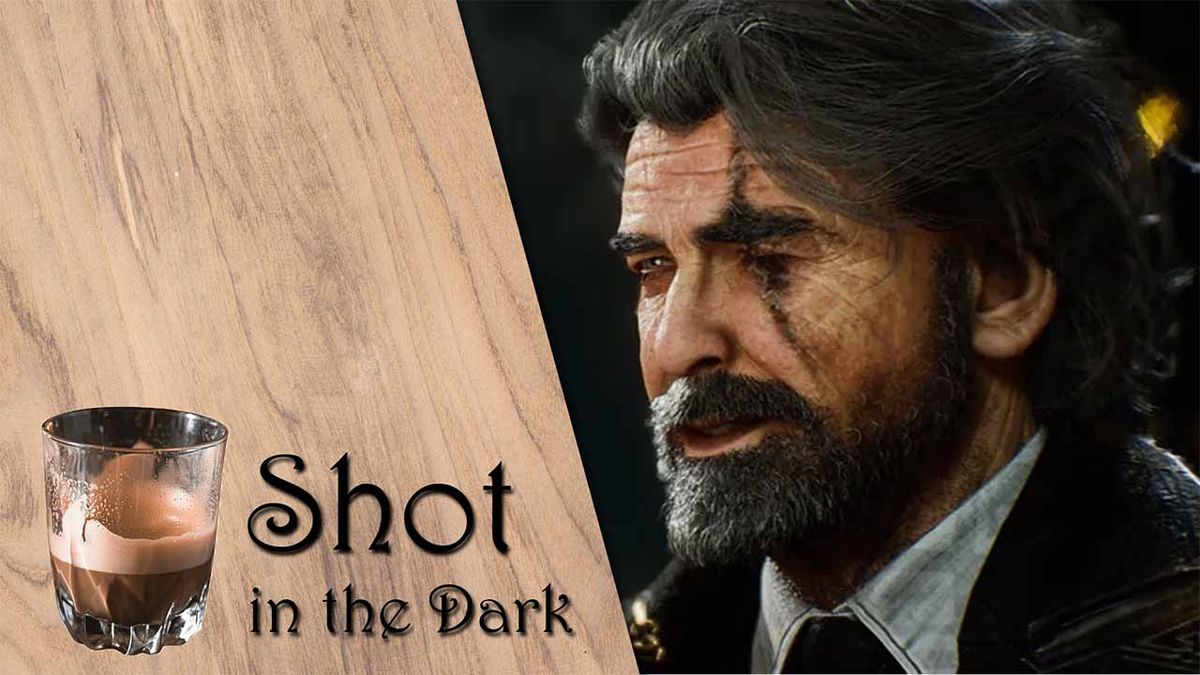
Renoir has been trying to bring his grieving wife back from her escapism in the painting. He saw what the painting did to her, how she became addicted to this painted reality in her grief. The only option he sees is to destroy the painting, so his wife can never return to it and is forced to acknowledge reality.
When Alicia approaches her father, she pleads with him not to follow through with this. She explains that she has hidden the painting in a location her mother won't find. Renoir is convinced that Aline would look for the painting and, in time, find it. When Alicia states that she, too, wishes to remain in the canvas, Renoir recognises the danger. Refusing to lose a daughter to the painted world, he hardens his resolve to destroy the painting.
I don't blame him. With what Renoir has seen, it makes sense he would refuse Alicia's pleas. She would have needed an entirely different plan to convince him. The option towards that third ending, which the letter promised.
But it doesn't exist.
Father Knows Best
Clair Obscur's second missed opportunity for choice lies in the same narrative beat: The inability to agree with Renoir.
Alicia is a teenager, and she behaves like a teenager, in the best sense. She's a convincing literary representation of one, and written very well. Playing the game as an adult in my thirties, however, I cannot help but agree with Renoir.
Given the current situation, he is right. He would lose his daughter to the painting, and he knows it. He makes his case with kindness, reason, and concern for his family.
Just like I wish there had been an option for Alicia to convince Renoir of another way to end this conflict and take the game down another gameplay route, I wish there was yet another option to just agree that he is right.
End the game right there, with a complete erasure of the painting.
This would still have been earned: Alicia was resolved to help Renoir when she initially entered the painting. She felt genuine relief at seeing him again, and showed obvious respect and love for him. As such, agreeing with Renoir should have been a possibility.
What we get instead is the convincing defiance of a teenager who thinks she's in the right: She flees the scene, regrouping to eventually beat her father and retake the canvas. Alicia eventually succeeds, and players are faced with the choice of either letting her stay in the canvas as she desires, or erase it and return home.
The ending in which she stays confirms Renoir's suspicions: Just like her mother before her, Alicia recreates the people she has lost inside the canvas. She chooses to live in a world where she has to acknowledge none of the sorrow she went through.
The other ending sees Alicia return home, the canvas erased, and shows the Dessendre family acknowledging the tragedy that befell them. Starting on the long path to healing.
In terms of framing and messaging, it is marked as the morally superior ending, which, while consistent with the game's overall themes, and a strong moral message, undermines the complexity the game could have displayed.
Rather than displaying its two outcomes as true equals, both with their pros and cons, Clair Obscur instead makes its preference for returning to reality clear. This, together with the lack of further options, is in stark contrast to the real moral complexity of the game.
Beyond the Binary
A binary choice can be entirely fine for a video game ending, but in this case it reveals an inability to let the player explore more freely: What could Alicia's "true ending" have looked like? Renoir is a reasonable character, and I'm sure we could have found something that convinced him of an alternative.
The other way to resolve this would have been a completely predetermined ending: Maelle struggles against Renoir and wins, only to lose to Verso in the end. This would have preserved Maelle's agency and characterisation, and firmly lead to the ending that the game itself frames as the superior moral choice.
As it is, the game lacks that final bit of nuance or assertion.
A game named after chiaroscuro, a painting style with harsh contrasts, should have either committed to that harshness, or found the ending past the binary choice.
One would have been a clear message about life being worth facing, even among the harshest circumstances. The other would have rewarded players who paid attention and wanted something better for their troubles.
Either could have been the masterstroke the game's canvas deserved.