You're not Buying Video Games
As an always-online game, The Crew requires a server to function, even for parts that are technically single-player. Ubisoft revoking the license means that you don't own the game anymore. The issue is that, legally, you never owned the game in the first place.


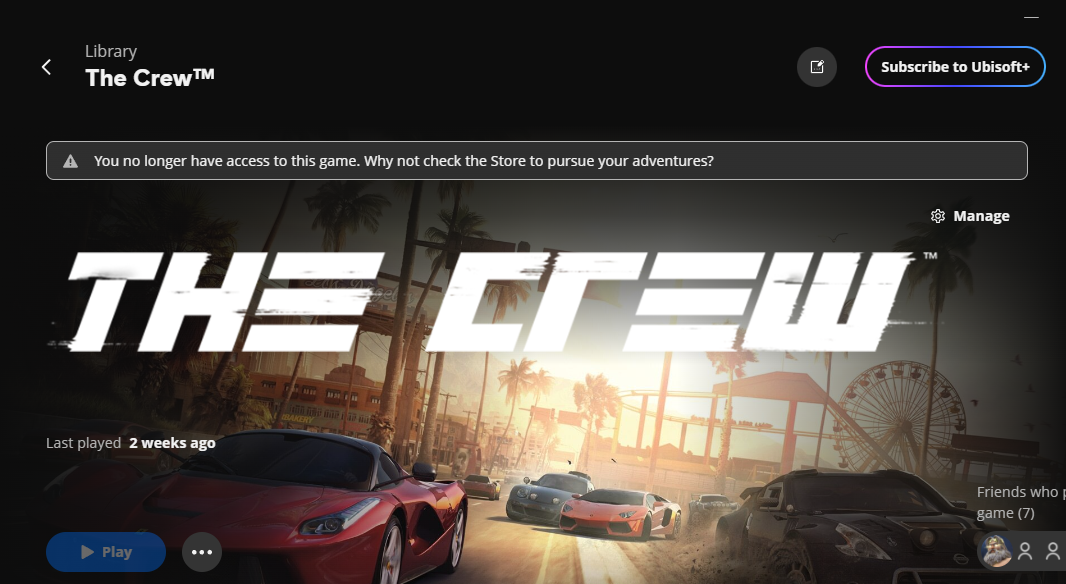
An article by PC Gamer reports that Ubisoft have begun to strip licenses for its game The Crew from people's libraries.
This is after the game servers went offline at the end of March 2024. As an always-online game, The Crew requires a server to function, even for parts that are technically single-player. Revoking the license means that you effectively don't own the game anymore.
The issue is that, legally, you never owned the game in the first place.
The Ownership Issue
When consumers buy a game, they think they are buying a game - my own language here betrays how we think about these things. We think of buying a game the same way we think of buying a book or buying something at a grocery store. It is a thing we own.
This did hold true to some extent back in the day, when we bought cartridges for our NESs, N64s and so on, when the entire game was on the cartridge and there was no online connection whatsoever. Even then, however, we never really owned the game, we were granted a licensed copy.
What is a purchase?
In general terms, a purchase is an agreement whereby ownership of a good is transferred from the individual offering it, to the person purchasing it (usually in exchange for money).
Ownership, meanwhile, means that the owner is free to do with their acquired good as they please.
They may use it for its intended purpose. They may use it for a different purpose. They may modify it, lend it to a different person, sell it, even destroy it.
The former owner has no way of complaining about what the current owner chooses to do with the good.
That is not what's happening with a licence agreement.
A Look at Ubisoft's EULA
This is where the EULA comes in. The End User Licence Agreement is the legal document everyone skips on starting that new game they just "bought". Let's take a look at Ubisoft's EULA as of 14.04.2024.
1. GRANT OF LICENSE.
1.1 UBISOFT (or its licensors) grants You a non-exclusive, non-transferable, non-sublicensed, non-commercial and personal license to install and/or use the Product (in whole or in part) and any Product (the “License”), for such time until either You or UBISOFT terminates this EULA.
To make sense of the initial part:
Ubisoft is granting you a license to use the product, but that license is:
a) non-exclusive: This license is not just granted to you, but to everyone entering this agreement.
b) non-transferable: You cannot give this license to your uncle, only you may benefit from it.
c) non-sublicensed: You yourself cannot grant the right to this license to another person, i.e. You cannot give someone else a copy of the game to play, only Ubisoft has that right.
d) non-commercial: You may not sell the product under license or any part of it, or otherwise use it commercially.
e) personal: This is a license granted to you, the person entering this agreement, and only you. Other users need their own license to play the game.
You must in no event use, nor allow others to use, the Product or this License for commercial purposes without obtaining a licence to do so from UBISOFT. Updates, upgrades, patches and modifications may be necessary in order to be able to continue to use the Product on certain hardware. THIS PRODUCT IS LICENSED TO YOU, NOT SOLD.
The final line of this article states quite clearly that this is not a purchase, it is a licence. Article 2 of the EULA elaborates on this by talking about what this means for ownership:
2. OWNERSHIP.
All title, ownership rights and intellectual property rights in and to the Product [...] and any and all copies thereof are owned by UBISOFT or its licensors. [...]
This License confers no title or ownership in the Product and should not be construed as a sale of any rights in the Product.
Consumers do not own these games, they own a license to play them. Ownership of the product remains with whoever is granting them the license.
Think about it this way: If you owned The Crew, you would have access to all of its source code, assets, server architecture etc. You could modify the game, lend it, resell it, destroy it, as per our earlier definition of ownership.
It wouldn't make a lot of sense if Ubisoft allowed you to do this, would it? This is why they offer a license instead, and that's what they mean when they say "not [...] a sale of any rights in the Product". You're not buying any of the rights associated with ownership in the way laypeople think about it.
With a license, Ubisoft retain ownership of the product, while they allow you to play a copy of the game in the way they intended.
Now let's talk about the end to this agreement:
8. TERMINATION.
The EULA is effective from the earlier of the date You purchase, download or use the Product, until terminated according to its terms. You and UBISOFT (or its licensors) may terminate this EULA, at any time, for any reason. Termination by UBISOFT will be effective upon (a) notice to You or (b) termination of Your UBISOFT Account (if any) or (c) at the time of UBISOFT’s decision to discontinue offering and/or supporting the Product. This EULA will terminate automatically if You fail to comply with any of the terms and conditions of this EULA. Upon termination for any reason, You must immediately uninstall the Product and destroy all copies of the Product in Your possession.
This states that the licence agreement is in effect the moment "you purchase or download the product", and that it can be terminated "at any time, for any reason" by either party.
This means that, legally, Ubisoft are well within their rights to revoke these licenses. Unless the terms of the EULA are fought in a court of law and found lacking, there is little pressure for Ubisoft or other companies to change these terms. This is especially true since they have been established practice for quite some time.
Everything Ubisoft has done here is perfectly legal. The EULA is enforceable, the termination clause is clear, and consumers agree to it the moment they download the game.
Legal, however, isn't the same as acceptable.
The reason this practice has gone unchallenged for so long isn't that it's ethical — it's that consumer protection law was written in a time when buying a thing meant owning a thing. Legal systems around the world haven't caught up to a world where the thing you "bought" can be remotely deleted from your library.
This isn't an oversight – it's a feature of how digital products have been designed and sold for the last twenty years. The only reason it has held is that no one has yet challenged this in court.
Until that happens, publishers operate in a legal space they themselves drafted. This naturally benefits them and enables them to dictate their terms to consumers, rather than negotiate. In this current system, it's consumers who carry all the risk.
This is where the example from my earlier piece comes in to illustrate that risk:
Imagine you bought a book at a bookstore, and after nearly 10 years, the Publisher came into your house, said: “Sorry, we’re not printing these anymore”, and took your book away from you – you wouldn’t accept that.
Challenging the EULA
Everything I have said on the current legality of Ubisoft's EULA assumes the EULA would hold up in court. While EULAs like this are standard practice in the U.S., other countries' legal stances might differ.
YouTuber Ross Scott has identified this and launched an initiative called "Stop Killing Games" to raise awareness and show people how they can make a difference:
"The videogame "The Crew", published by Ubisoft, was recently destroyed for all players and had a playerbase of at least 12 million people. Due to the game's size and France's strong consumer protection laws, this represents one of the best opportunities to hold a publisher accountable for this action. If we are successful in charges being pressed against Ubisoft, this can have a ripple effect on the videogames industry to prevent publishers from destroying more games."
Ross is likely right that France is a strong starting point for a campaign such as this. It should not be impacted by Ubisoft's revocation of licenses, as it operates using proofs of purchase. These should still be available in your account history, or as physical receipts.
Taking this to the courts would require someone to sue publishers over the contents of their EULAs. The time, money, and knowledge required are considerable, which makes it a daunting prospect.
Petitions, on the other hand, are a much lighter legal instrument.
They don't force a direct legal confrontation. They merely request that a country's legislative body examine a particular issue. This means that any action deemed necessary is backed directly by a country's political weight, not just individuals. This is a much stronger negotiating position. If petitioned governments do find that these EULAs break their laws, some form of action is likely.
Stop Killing Games dares to ask a question that individual consumers and companies alike have avoided. It does so using an established legal instrument that does not impose demands outright but tells legislators:
"We, your citizens, are bringing this issue to your attention and trust you to examine it properly." Issuing the legal challenge, if deemed necessary, is the legislator's responsibility.
This takes citizens out of the line of fire, and gives legislators the option of drafting new policy directly. In the best case, this forces companies to comply. In the worst case, it has started a conversation that was previously not on the political agenda. I think it's worth supporting either way. It is high time consumer protection laws were updated to reflect current commercial realities. That way, they can continue to do what they are supposed to – protect consumers from practices that put them on the legal back foot.